
BOOK I · THE INNER ARCHITECTURE TRILOGY
Why Study Personality?
The Self That Didn’t Choose Itself
Personality can be studied as a set of traits, habits, and patterns, but that leaves a deeper question unanswered: what is the relationship between the pattern and the one who knows it? Why Study Personality? begins with Enneagram type and follows the inquiry toward the construction of identity itself.
Read the FAQs
Get the Book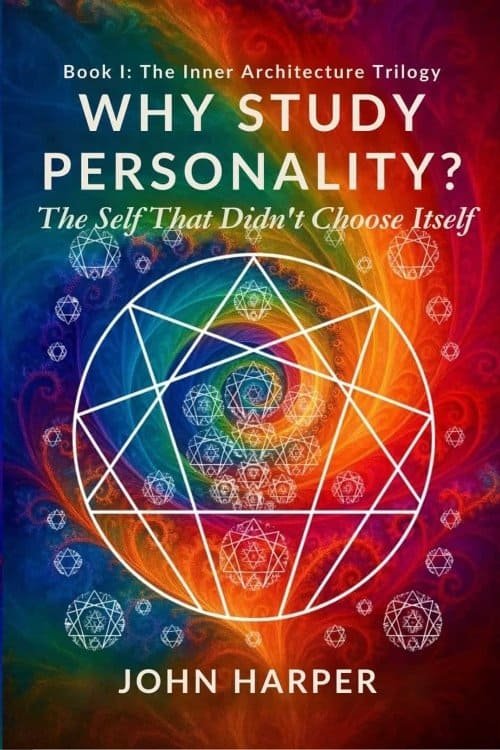
THE CENTRAL QUESTION
Am I my Enneagram type?
Your type describes a recurring organization of attention, perception, emotion, and behavior. Because that organization becomes habitual and largely automatic, it can eventually feel like identity itself. The deeper purpose of studying personality is not simply to describe the pattern more accurately, but to recognize the difference between having a pattern and being the pattern.
WHAT YOU’LL DISCOVER
A different reason to study personality
This book uses the Enneagram not simply to describe personality, but to investigate how recurring patterns of attention, perception, emotion, and behavior become organized into a sense of self.
How personality becomes identity
Recurring patterns of attention, perception, emotion, and behavior gradually become so familiar that we experience them not merely as patterns, but as who we are.
Why knowing your type is not enough
Accurate self-description can increase understanding without necessarily loosening identification with the personality structure being described.
How attention organizes experience
What we habitually notice, ignore, emphasize, and anticipate helps shape the world we experience before conscious interpretation begins.
The relationship between perception and personality
Personality does not simply react to experience. It participates in selecting, organizing, and interpreting what becomes experience in the first place.
Why patterns repeat even when we understand them
Insight can change the story we tell about ourselves while deeper habits of perception, emotion, and identification continue operating automatically.
What self-observation actually reveals
Observation makes it possible to distinguish the activity of personality from the awareness that can recognize that activity as it occurs.
KEY CONCEPTS
Questions the book investigates
What is personality?
Personality is the recurring organization through which attention, perception, emotion, memory, and behavior become patterned over time. These patterns are useful adaptations, but because they become familiar and automatic, they can gradually be experienced as the self rather than as activity occurring within experience.
How does a personality pattern become an identity?
Repetition creates familiarity, and familiarity creates a sense of continuity. When the same ways of attending, interpreting, feeling, and responding recur across situations, the pattern begins to feel less like something we do and more like who we are.
Why doesn’t understanding my type necessarily change it?
Understanding can make the pattern more visible without changing the organization that produces it. A person may recognize motives, defenses, and habitual reactions with considerable accuracy while still experiencing them as “me” and continuing to organize experience through them.
What is the difference between observing personality and identifying with it?
Identification means experiencing the personality pattern from inside it, as though its reactions, interpretations, and self-images are simply reality. Observation introduces a different position: the pattern can be noticed as activity. That distinction opens the possibility of recognizing personality without taking it as the whole of who we are.
Ready to go deeper?
Why Study Personality? follows the question beyond type description into the deeper organization of identity. It explores what becomes possible when personality can be seen clearly without being mistaken for the whole of who we are.
Buy the BookRead the FAQs · Read the Introduction · View the Table of Contents