Deconstructing the Enneagram
What Organizes Experience into the Appearance of a World?
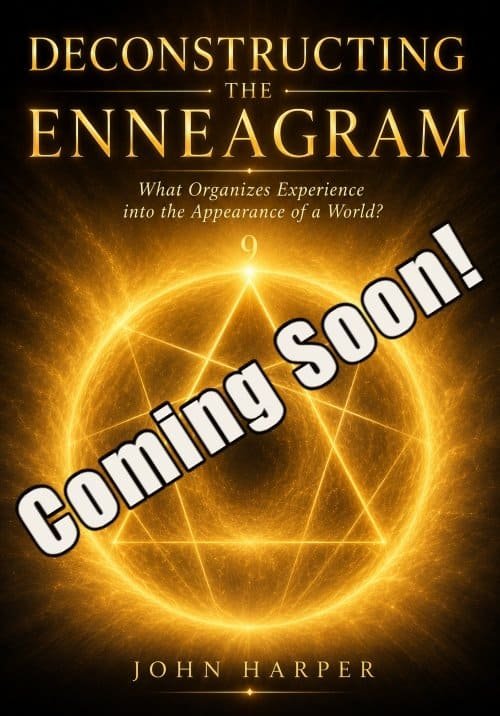
Deconstructing the Enneagram begins by stripping away the explanations that have accumulated around the symbol: the Western octave, ancient provenance, the Sarmoung story, the personality overlay, and the assumption that the Enneagram is fundamentally a typology. What remains is the geometry itself: circle, triangle, and hexad, raising a more basic question about how experience becomes organized at all.
THE CENTRAL QUESTION
What is the Enneagram?
The book does not begin by assuming that the Enneagram is a personality system, a musical law, or an inherited esoteric doctrine. It asks what remains when those interpretations are temporarily set aside. The symbol then appears less as a diagram of character and more as a geometry of organization: a field, organizing forces, and lawful movement through that field. Personality becomes one expression of this deeper organization rather than the symbol’s definition.
WHAT YOU’LL DISCOVER
What remains when the explanations are removed
Deconstructing the Enneagram follows a sustained inquiry into the assumptions that make the familiar Enneagram seem self-evident. Instead of replacing one interpretation with another too quickly, it asks what can be observed when history, authority, mathematics, personality theory, and even the observer’s position are subjected to the same scrutiny.
Why the musical octave is not the foundation
The traditional Western octave may illustrate certain features of process, but its structure is culturally contingent and cannot establish a universal law on its own.
What the geometry suggests without personality
The circle suggests totality, the triangle organizing force, and the hexad lawful movement. Together they point toward organization rather than character.
What history can and cannot establish
Type can function as a repeated regulatory solution for managing charge, coherence, activation, and contact.
Why explanation can stand between us and experience
An explanation can become so immediate that it categorizes a living event before the event itself is fully felt, turning knowledge into another layer between awareness and experience.
Why personality is an application, not the symbol itself
Nothing in the geometry requires nine personality types. The personality system is a later interpretive use of the symbol, not something visibly contained in the drawing itself.
Why direct observation becomes the final authority
As inherited supports loosen, the question shifts from who taught something or how old it is to whether the principle can be found in lived experience.
KEY CONCEPTS
Questions the book investigates
Is the Enneagram fundamentally a personality system?
The symbol existed before its modern personality interpretation. Its geometry contains a circle, triangle, and hexad, but nothing in those forms requires assigning nine personality types. The personality system may be useful and observationally valid while still remaining one application of a larger symbol.
What remains when personality is removed from the symbol?
What remains is a circle, triangle, and hexad organized into one figure. Read without the personality overlay, these elements suggest totality, differentiation, organizing force, and lawful movement through a field. The symbol begins to look like an inquiry into organization itself.
What must exist before process can occur?
The book follows the Law of Seven backward toward a prior question. Process cannot simply float in abstraction; it must occur within some field or totality. The fact that the hexad is drawn inside a circle raises the question of the field that precedes, contains, and makes process possible.
How does the many arise from the One?
As the inquiry moves beneath typology and process, it arrives at the relationship between unity and multiplicity: how differentiation arises within a field that precedes it, how organization emerges without abandoning that ground, and whether this can be found directly in experience rather than only in philosophical explanation.
Ready to go deeper?
Deconstructing the Enneagram removes the familiar explanations one by one until the symbol can be encountered again as a question rather than an answer. What begins as an investigation of history, mathematics, and typology becomes an inquiry into process, organization, perception, and the field within which a world appears.
Buy the BookRead the FAQs · Read the Introduction · View the Table of Contents