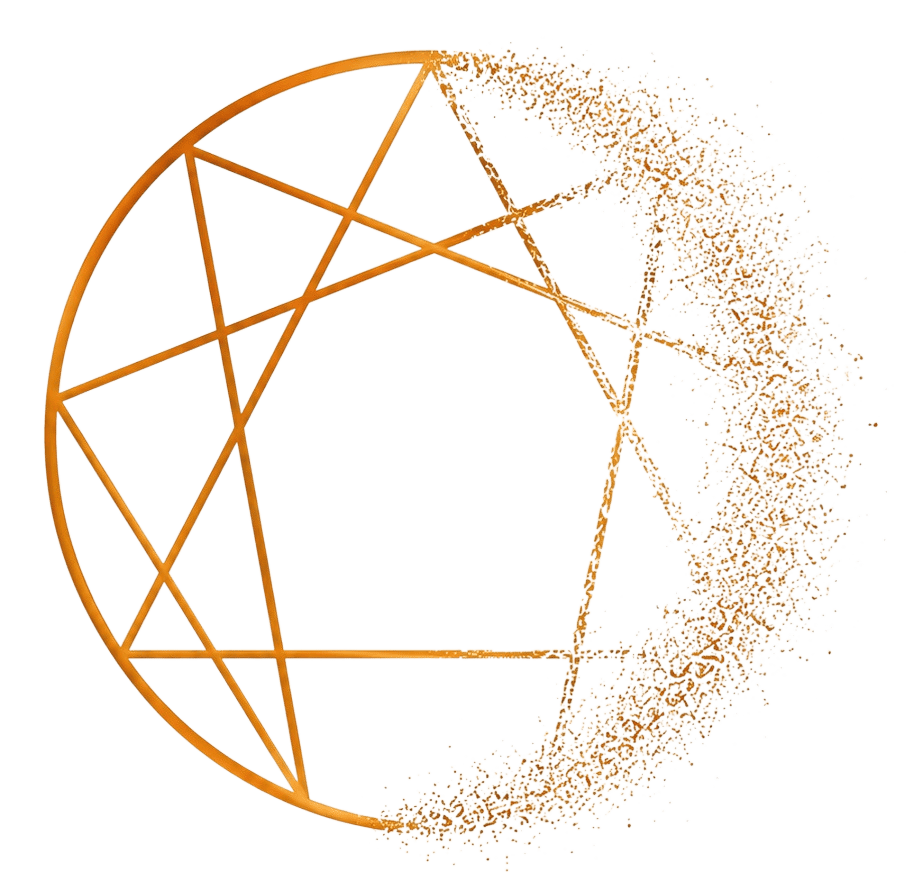
How did one symbol become two different systems?
Today, the word Enneagram most often refers to a system of nine personality types. People learn their type, study motivations and defenses, explore wings and instincts, and use the system to understand relationships, behavior, and personal growth.
But the symbol itself points to a broader use. Before personality descriptions were placed on the nine points, the Enneagram represented process: how movement unfolds, how patterns become organized, where development becomes mechanical, and where new influence is required if a process is to continue rather than repeat.
These two uses of the Enneagram overlap, but they ask different questions.
The Enneagram of Personality asks, “What kind of personality structure do I have, and how can I understand and work with it?”
Enneagram as Process asks, “How does experience become organized into recurring patterns, and what makes transformation possible when those patterns become mechanical?”
The distinction matters because personality is only one thing the Enneagram can illuminate, not the whole of what the symbol can map.
What does the Enneagram of Personality map?
The Enneagram of Personality maps recurring structures of motivation, attention, emotion, defense, and behavior. Its nine types provide a way of recognizing characteristic patterns through which people interpret experience, protect themselves, relate to others, and maintain a familiar sense of identity.
A simplified flow looks like this:
Early adaptation → Core beliefs and desires → Defense mechanisms → Fixation and passion → Automatic personality behavior → Self-awareness → Integration
This approach has substantial value. It can help people understand why they react as they do, identify recurring defenses, become more conscious of habitual patterns, and develop greater flexibility in relationships and behavior.
Its primary frame, however, remains personality. The central question is how the type operates, how it becomes healthier, and how a person can respond with more awareness rather than from automatic patterning.
What does Enneagram as Process map?
Enneagram as Process begins from a different starting point. Instead of asking first which personality type a person has, it asks how any process becomes organized, how that organization becomes repetitive, and what allows movement to continue when the process begins to become mechanical.
A simplified flow is:
Process → Organization → Perception → Personality → Mechanical Repetition → Shock → Transformation
Here, personality is not the starting point. It is one stage in a larger movement.
Experience becomes organized. That organization conditions perception. Repeated patterns of perception, feeling, and response gradually stabilize into what we call personality. Once established, the pattern tends to repeat itself mechanically because each repetition reinforces the organization that produced it.
Transformation therefore requires more than understanding the pattern. At certain points, new influence must enter the process. This is the function of shock: an interruption in automatic continuity that makes a different movement possible.
The Enneagram then becomes a map not only of what personality looks like, but of how organization forms, how repetition sustains itself, and where conscious participation can alter the course of a process.
Where do the two approaches overlap?
The two approaches are not opposites. Both recognize that much of human behavior is automatic, that recurring patterns can organize perception and response, and that greater awareness can create more freedom.
Both focus on the movement from unconscious repetition toward conscious participation. Both can use self-observation, attention, emotional awareness, and recognition of habitual defenses. Both can help a person see that what feels immediate and personal is often conditioned by patterns that have become familiar through repetition.
The difference is not whether change matters. It is what the Enneagram is being used to understand. In the personality orientation, the pattern itself is the primary field of study. In the process orientation, personality is one expression of a larger dynamic through which experience becomes organized, stabilized, interrupted, and potentially transformed.
Where do they fundamentally diverge?
The divergence appears most clearly in the question of transformation.
The Enneagram of Personality usually asks how a person can become a healthier, freer, more integrated expression of type. That can involve greater emotional regulation, better relationships, less reactivity, more flexibility, and a more conscious response to familiar patterns.
Enneagram as Process asks whether transformation involves something deeper than improved functioning. If personality is an adaptive organization occurring within consciousness, then the deeper question is whether that organization continues to define identity.
From this perspective, the aim is not simply to produce a better personality. It is to see the mechanics of personality clearly enough that identification with the structure can begin to loosen. Personality can continue to function, often more freely and intelligently, without remaining the unquestioned center of who we take ourselves to be.
Personality Typology and Living Process Compared
Enneagram of Personality
Enneagram as Process
Primary focus
Who am I, and why do I react this way?
How does experience become organized into mechanical repetition?
Primary focus
Personality type, motivation, defense, and growth
Process, organization, interruption, and transformation
View of personality
The primary field being described and developed
An adaptive organization arising within a larger process
Role of type
A framework for understanding recurring character patterns
Evidence of how experience has become organized and stabilized
Central movement
Unconscious pattern → conscious response
Mechanical repetition → interruption → new movement
Use of the symbol
Organizes nine personality structures and their relationships
Reveals relationships among forces, stages, intervals, and movement
Direction of the work
Greater flexibility and freedom within personality
Seeing the process clearly enough to participate consciously in transformation
Personality may be where we encounter the Enneagram, but it does not have to be where the investigation ends
For many people, personality type is the doorway into the Enneagram. It provides immediate recognition and a language for patterns that may have operated unconsciously for years. That makes typology a powerful entry point.
But once the pattern is visible, a deeper inquiry becomes possible. How did this organization form? What keeps it repeating? What does the geometry of the symbol contribute beyond description? Where does automatic movement require interruption? What happens when personality is no longer taken as the whole of identity?
This is where the Enneagram begins to function as more than a personality system. It becomes a way of investigating the process through which experience becomes organized, repetition becomes mechanical, and conscious participation becomes possible.