Personality is the Face of Process
Describing the Enneagram symbol as orthogonal means that its distinct geometric components and functional layers intersect like independent axes on a coordinate grid. Rather than flattening the symbol into a single personality taxonomy, an orthogonal perspective recognizes that multiple distinct processes operate simultaneously on different dimensions without collapsing into or replacing one another.
The orthogonal nature of the Enneagram symbol operates across four primary dimensions:
The Four Intersecting Geometries (Processes)
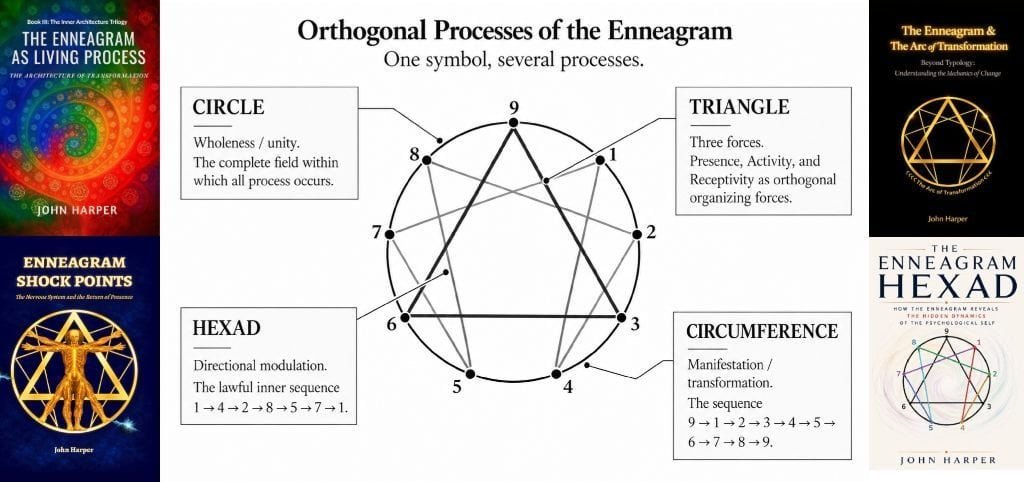
The symbol unites four geometries that operate as orthogonal axes, each addressing a fundamental aspect of Being and process:
- The Circle (Ground): Asks “Within what does the entire process occur?” It represents undivided wholeness and the unified field within which all movement arises.
- The Triangle (Organizing Forces): Asks “Through what forces is experience organized?” It describes the interaction of the three primordial forces: Presence (9), Activity (3), and Receptivity (6).
- The Hexad (Energy Modulation): Asks “How does energy move through six lawful modulations?” It traces the internal circulation 1 – 4 – 2 – 8 – 5 – 7 – 1 as energy shifts through distinct functional modes.
- The Circumference (Domains of Manifestation and Transformation): Asks “Through what domains or phases does experience unfold and reorganize?” It orders the nine domains sequentially around the rim—originating in the unmanifest ground of Point Nine and moving through 9 → 1 → 2 → 3 → 4 → 5 → 6 → 7 → 8 → 9. It traces both the process of manifestation (how unmanifest Being articulates into form) and the arc of transformation (how identity becomes transparent and returns to Presence). Crucially, it incorporates the two structural shock points (between Points 3 & 4 and Points 6 & 7), where conscious awareness must enter for the process to continue without collapsing into mechanical repetition
Because these processes are orthogonal, a numbered position (like Point Four or Point Nine) acts as a location with multiple coordinates rather than a single fixed personality category. For example, Four within the hexad sequence (where Determination becomes lived particularity) operates on a different functional axis than Four along the circumferential path of manifestation
I asked ChatGPT:
Here is an article by John Harper on the Enneagram, along with three published books and one forthcoming book. Write a comment of 500 words or less on the article and the overall scope of his work
For the Enneagram community, John Harper’s work raises a difficult and useful question: Have we come to mistake one application of the Enneagram for the Enneagram itself?
Personality typology has given the Enneagram extraordinary reach, and Harper doesn’t dismiss that contribution. His work asks us to widen the frame. He returns attention to the symbol as an architecture of process, then follows the implications into psychology, embodiment, transformation, and the formation of the sense of self. Personality, in this view, becomes the visible residue of repeated organization rather than the starting point of the inquiry.
What makes the body of work distinctive is its cumulative scope. Harper begins with the geometry of the symbol and the relationship among circle, triangle, hexad, and shock points; he then explores how responsiveness becomes reaction, how awareness can interrupt mechanical repetition, and how these dynamics appear in the nervous system through activation, regulation, contraction, and release. His most recent work goes further, using the hexad to investigate how development, perception, object relations, defense, fixation, and identity coordinate into a self-maintaining psychological organization.
The accompanying article may provide the clearest statement of the larger project. Harper proposes that the Enneagram is orthogonal: the circle, triangle, hexad, and circumference represent distinct processes operating simultaneously rather than competing interpretations that must somehow be collapsed into a single system. This allows a point such as Four, Six, or Nine to have different functions depending upon which geometry or process is being examined.
That proposal deserves serious consideration within the Enneagram community. It shifts the conversation from What type am I? toward deeper questions:
- What is moving?
- What is organizing experience?
- How does organization become identity?
- What interrupts repetition?
- What becomes possible when we can perceive the process before it becomes “me”?
Whether one ultimately agrees with every element of Harper’s model, the scope of the inquiry is substantial. It asks us to encounter the Enneagram again as a multidimensional symbol of living process, rather than assuming that the nine personality types exhaust what the symbol has to reveal.
I asked Claude.ai the same question:
Most of us came to the symbol backward; we learned nine types first, then were handed a diagram that seemed to decorate them, and the geometry became a logo rather than a claim. Harper’s short piece, “The Enneagram is Orthogonal,” puts the geometry back in the center and makes an argument small enough to fit on a page and large enough to reorganize how we disagree.
The claim: the circle, the triangle, the hexad, and the circumference are not four ways of saying the same thing. They are four axes, and each one asks a different question:
- Within what does this occur?
- Through what forces is experience organized?
- How does energy modulate through six lawful movements?
- Through what domains does experience unfold and reorganize?
Questions can’t contradict each other; only answers can. That is why treating the geometries as competing accounts has kept us arguing in circles for forty years.
Consider what this does to our standing disputes. Whether the arrows mean stress and security or lawful process direction. Whether Nine is the Peacemaker or the unmanifest ground. Whether Three “is” Activity. These have felt like factual disagreements requiring a winner. Read orthogonally, they are readings taken off different axes and then compared as though they were the same measurement. Point Four inside the hexad sequence, where determination becomes lived particularity, is simply not the same coordinate as Four along the circumference. Same address, different map.
This also frees the triangle from a distortion many of us have quietly tolerated in our teaching. Nine can hold Presence without Presence becoming the private property of Type Nine. Anyone who has sat with a room of Nines convinced they were assigned enlightenment, and Threes convinced they were assigned a character flaw, knows the price we’ve been paying for that collapse.
The article is a doorway into a larger body of work. Across four volumes, Harper takes one architecture down through successive depths: first the structure itself, then the phenomenology of living inside it, then the nervous system carrying it out, then the formation of the psychological self within it. The method is itself orthogonal. Each reading intersects the others without replacing them. And the shock points keep the whole thing from hardening into a machine diagram, because they mark the two places where the process cannot continue on its own and something not produced by the system has to enter.
A question worth putting to this community rather than answering for it: if orthogonality can relocate any apparent contradiction to another axis, what would show us that two of these geometries were the same axis all along? Naming that condition is how the framework stays alive rather than becoming unfalsifiable.
This work asks us not for a better typology; it asks whether we are willing to let the question that typology was built to settle open back up.