
The Enneagram Hexad: FAQs
Frequently Asked Questions
The Enneagram Hexad: How the Enneagram Reveals the Hidden Dynamics of the Psychological Self investigates how experience becomes organized into the familiar sense of being someone. It follows the relationships among perception, emotion, attention, bodily response, and action, showing how their repetition gives personality its recognizable stability. The Enneagram’s inner six-point figure provides a map for exploring this process directly.
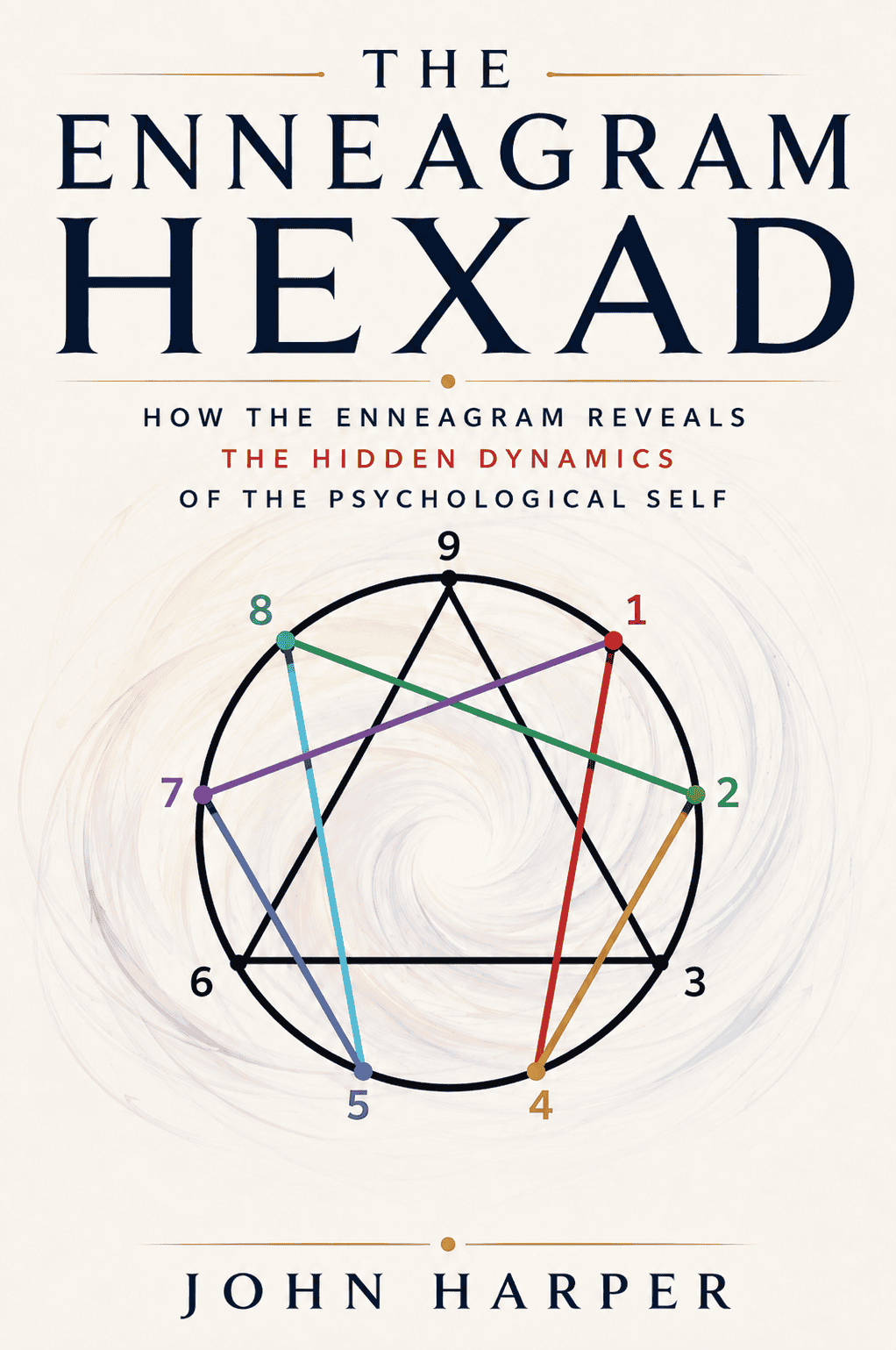
What is the hexad?
The hexad is the six-point figure traced by the sequence 1 → 4 → 2 → 8 → 5 → 7 → 1. In this book, its points represent six functions participating in every human life.
- 1 — Determination: defining, selecting, and giving form.
- 4 — Individuation: becoming particular, differentiated, and personally meaningful.
- 2 — Relationship: connecting, responding, and participating with others.
- 8 — Autonomy: initiating, asserting, and acting from oneself.
- 5 — Containment: holding, regulating, and metabolizing experience.
- 7 — Expansion: opening toward possibilities, alternatives, and what is unfamiliar.
Each function participates in two tension fields, receiving what has developed before it and contributing to what follows.
How does this approach relate to the Enneagram of Personality Types?
The Enneagram of Personality Types describes recognizable patterns of motivation, attention, defense, and behavior. This book investigates the processes through which such patterns form and continue. All six hexad functions participate in everyone’s experience, whatever their type. Knowing your type can provide useful context, while the inquiry goes beyond the description to the organization beneath it.
What are the six tension fields?
The six tension fields connect Determination with Individuation, Individuation with Relationship, Relationship with Autonomy, Autonomy with Containment, Containment with Expansion, and Expansion with Determination.
These relationships become tangible in ordinary situations: expressing a difference while remaining connected, receiving the consequences of an action, staying with what is present as new possibilities arise, or making a commitment that excludes other options. Each field contains a range of possible responses, some more available to us than others.
What are preferred ranges?
Preferred ranges are the regions within a tension field that our psychological organization has learned to inhabit with relative familiarity. Someone may sustain independence easily while finding receiving help uncomfortable. Another may welcome possibilities yet experience considerable charge when a choice becomes definite.
w your Enneagram type?
Preference alone does not establish fixation. The question is what happens when circumstances call for a response beyond the familiar range. Bodily tension, emotional urgency, judgment, or an impulse to restore the previous arrangement can reveal its edge.
What does “dynamic inertia” mean?
Dynamic inertia describes how the psychological self maintains continuity through movement. We adjust, make decisions, revise explanations, seek contact, withdraw, and change direction while preserving a recognizable way of being.
A whirlpool offers a useful image: its form persists while the water that makes it up continually changes. Personality can maintain a similar continuity through the ongoing coordination of changing experiences and responses.
How does the nervous system participate?
Psychological organization includes bodily readiness as well as thought and meaning. Breathing changes, muscles tighten, attention narrows, and impulses prepare before we consciously recognize a response. These movements help regulate what we can receive and sustain.
The book includes the nervous system within its investigation while distinguishing it from the soul, understood here as individual consciousness or a self-aware field of sensitivity. Their interaction makes psychological organization something we can feel and understand.
What do early relationships have to do with the hexad?
Early relationships help establish what feels possible, tolerable, and necessary. Expressing a preference, needing support, exploring independently, or showing distress acquires meaning through the responses a child encounters.
Repeated interactions become internally available as object relations: familiar experiences of self-with-other, carrying emotion, expectation, and bodily response. Later encounters can activate these configurations even when the original people and circumstances are absent.
Does the hexad describe a sequence or a simultaneous process?
The directional sequence helps us examine how one function conditions the next. In adult experience, these relationships can operate together so quickly that we encounter a whole configuration before recognizing its movements.
A brief disagreement may involve personal meaning, expectations of the other person, an impulse to act, selective attention, and imagined outcomes almost at once. The book moves from studying the sequence to recognizing this simultaneous organization, which it describes as a chord.
Does transformation mean balancing the six functions?
Freedom has no required midpoint. A situation may call for a firm boundary, sustained closeness, decisive action, patience, or openness to an unfamiliar possibility. An ideal of balance can become another standard we use to judge and regulate ourselves.
The inquiry concerns whether we can respond to the actual situation, including the charge that arises when its demands exceed our familiar range. Greater freedom includes having preferences without requiring them to preserve our identity.
What is the role of Presence?
Presence is the immediate actuality of Being, available within experience. The book distinguishes it from concentration, mental observation, and an improved self-image.
When the familiar response does not immediately complete, a gap can open in psychological continuity. Presence can then participate more explicitly in the process. The book uses shock to disrupt the established psychological coherence produced through that participation.
Does seeing the process make personality disappear?
Personality remains part of human functioning, along with memory, practical skills, relationships, and the continuity needed to live a life. What can change is our identification with its organization.
As the process becomes more transparent, we can recognize a familiar reaction as something forming within experience. Its urgency may remain, yet there can be more room to receive what is happening and discover how to respond.
How does this book relate to Enneagram Shock Points?
Enneagram Shock Points investigates why understanding a pattern may leave its deeper emotional, relational, and bodily organization intact. The Enneagram Hexad examines how that organization operates through interacting functions and tension fields.
Read together, the books offer complementary ways to investigate persistence and transformation: where familiar patterns are maintained, how they continually recreate themselves, and how Presence can participate in their unfolding.