
What does The Alchemy of Perception help me understand?
This book asks a foundational question: How does perception shape the world we experience?
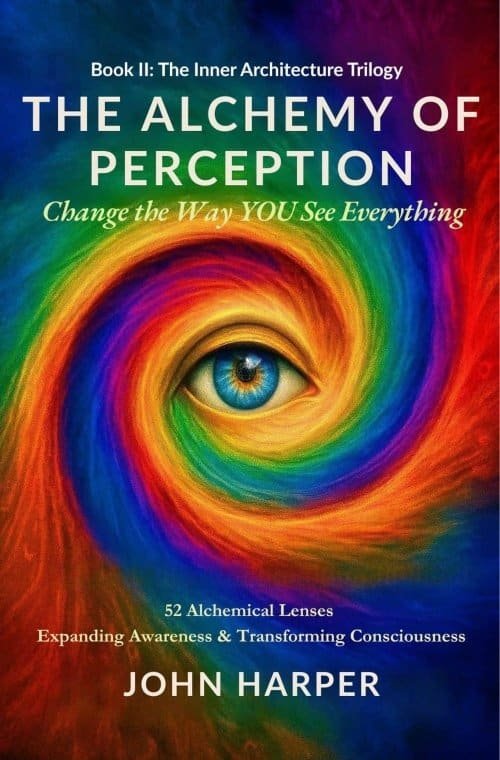
The Alchemy of Perception explores the difference between direct perception and the layers of interpretation that quickly organize what we see. It distinguishes apprehension—immediate, pre-conceptual contact with experience—from recognition, the process through which memory, naming, expectation, and prior knowledge begin to shape what appears.
The book is structured as a practical exploration of perception through thirteen domains and fifty-two lenses. These lenses reveal how assumptions, reactions, judgments, memory, emotion, identity, relationship, and meaning continually influence experience. The aim is not to tell you what to see, but to refine how seeing happens.
From this perspective, transformation begins when perception becomes less automatic and more transparent. The work invites you to notice the difference between what is actually present and what memory, conditioning, and interpretation add to it, so that awareness can participate more directly in experience rather than simply repeating the past.
Ultimately, the book moves beyond improving perception as a cognitive skill. Its deeper inquiry is into the relationship between the perceiver, the perceived, and awareness itself — until perception becomes less a way of constructing a familiar world and more a direct participation in what is actually here.
Frequently Asked Questions
“Perception is not the window through which you see the world—it is the glass itself, shaping what appears.”
The Alchemy of Perception explores a deceptively simple question: What actually happens when we perceive something? We ordinarily assume that the world appears and we simply see it. The book examines the layers of attention, memory, expectation, emotion, identity, and interpretation through which what appears becomes the experience we call reality. Its deeper inquiry eventually turns perception back toward the perceiver and asks whether awareness is something a separate self possesses, or the field within which both self and world appear.
Do we perceive reality directly?
Ordinarily, we do not experience reality without mediation; we experience reality through biological, psychological, and perceptual filters. Sensation occurs, but almost immediately the mind selects, organizes, compares, remembers, names, and interprets what is being encountered.
The Alchemy of Perception distinguishes the immediate contact of experience from the recognition that follows it. Before the mind concludes what this is, there is an initial apprehension: sound, color, sensation, movement, presence. Recognition then connects that fresh experience with memory and previous knowledge. This ability is essential for functioning, but it also means that what we consciously experience already contains our history.
The book therefore invites us to become increasingly sensitive to the moment before interpretation solidifies, allowing us to encounter reality more directly rather than only through what we already know.
How does perception shape the reality we experience?
Perception shapes experience by selecting, organizing, and interpreting what appears before we become consciously aware of the completed experience. Attention does not receive everything equally. Memory, expectation, fear, desire, conditioning, and identity influence what becomes prominent, what disappears into the background, and what meaning is assigned to what remains.
This does not mean that we magically create the external world. The book explicitly distinguishes the existence of the world from our experience of it. The world may exist independently of our perception, while the world as experienced is inseparable from the perceptual processes through which we encounter it. Two people can therefore meet the same situation and inhabit remarkably different experiential worlds.
What is the difference between perception and interpretation?
Perception begins with immediate contact; interpretation organizes that contact into something known and meaningful. The Alchemy of Perception uses the distinction between apprehension and recognition to make this visible.
Apprehension is the initial, preconceptual meeting with experience: the vibration of sound before identifying its source, the sensation in the body before calling it anxiety, the movement of color before deciding what object is being seen. Recognition follows almost instantly, connecting what is happening now to memory and saying, in effect, I know what this is.
Recognition gives coherence to experience and makes ordinary life possible, but it can also obscure what is actually present by replacing fresh perception with familiar interpretation. The practice is therefore not to eliminate interpretation but to become capable of recognizing when it has taken over.
How do memory and expectation change what I see?
Memory and expectation influence what you notice, what you overlook, and what meaning you assign to what happens. The mind does not approach each moment empty. It carries previous experiences, beliefs, emotional associations, assumptions, and expectations into the present.
This is why the book repeatedly asks questions such as: What am I expecting to see? What am I assuming? What evidence am I overlooking? Beliefs can direct attention toward evidence that confirms them while filtering out what contradicts them. The result is a perceptual loop: expectation influences perception, perception appears to confirm expectation, and the expectation becomes even more convincing.
Inquiry interrupts that loop by helping us see beliefs as interpretations rather than unquestioned facts.
Why do two people experience the same event so differently?
Two people can encounter the same event differently because perception is shaped by different histories, expectations, emotional states, meanings, and patterns of attention. The event may be shared while the experienced reality is not.
A look from another person might register as affection to one person, criticism to another, and barely be noticed by a third. The difference does not necessarily lie in the event itself; it lies partly in how each nervous system and mind organize what the event means.
The book gives the simple image of two people standing at the same window: one sees beauty, another sees threat. The window has not changed. The perceivers bring different organizations of experience to what appears.
Understanding this can introduce considerable humility into relationships. We begin to recognize that what feels unquestionably true to us may contain both what happened and the way our particular history has learned to see it.
How does personality influence perception?
Personality influences perception by directing attention toward some aspects of experience while habitually overlooking or avoiding others. From this perspective, Enneagram type is not simply a collection of behaviors or traits; it is also a characteristic pattern of perceiving.
One person’s attention may repeatedly move toward achievement and value, another toward threat and certainty, another toward maintaining harmony, conserving resources, preserving autonomy, or seeking intensity. When these attentional movements repeat, they help construct the coherent experience called “me.”
The Alchemy of Perception therefore uses the Enneagram as a map of attention rather than primarily as a labeling system. The useful question becomes less Which type am I? and more Where does my attention automatically go, what does it exclude, and how does that movement create the world I repeatedly inhabit?
Can changing how I perceive actually change my experience?
Yes. When the organization of perception changes, the experience that emerges from it can change even when the external facts remain the same. This does not mean denying reality or replacing an unpleasant interpretation with a pleasant one.
The book describes perceptual flexibility as the capacity to recognize that any interpretation is partial. A painful event can remain painful while revealing previously invisible dimensions: resilience, learning, relationship, opportunity, vulnerability, or meaning. The facts have not changed, but the experiential world surrounding those facts has expanded.
This is why changing meaning can also alter identity. If the meaning of an event has helped organize the story of who you are, seeing the event differently can loosen the identity built around that interpretation.
What happens before the mind names or interprets an experience?
Before interpretation, there is immediate contact: sensation, perception, and awareness meeting what is present before the familiar conceptual world has fully formed. The book calls this initial movement apprehension.
A sound can be heard before being recognized as a bird. Tightness can be felt before being named fear. Color and shape can appear before the mind says tree. This interval is extraordinarily brief in ordinary consciousness because recognition follows almost immediately.
Yet that small interval matters. It reveals that experience does not begin with concepts. Concepts arrive within experience. The Alchemy of Perception treats cultivating sensitivity to this preconceptual moment as a doorway into direct perception, because for an instant we encounter what is present before memory tells us what it must mean.
What is direct perception?
Direct perception is contact with experience before thought, memory, and interpretation completely organize it into something already known. It is not sharper eyesight or more detailed sensory observation. It is a change in the relationship between awareness and what appears.
The book describes direct perception as “knowing without mediation,” where awareness meets appearance before conceptual interpretation divides experience into familiar categories. This does not require becoming incapable of recognition. Recognition still has a practical function. The shift is that recognition becomes transparent enough that it no longer completely replaces immediacy.
Direct perception therefore has a contemplative dimension. One discovers that seeing, hearing, sensing, and knowing are occurring before the mind establishes a separate commentator who claims the experience.
How does the story I tell about myself shape what I experience?
Your self-story shapes experience by determining what receives attention, how events are interpreted, and which experiences are accepted as evidence of who you are. Identity is partly narrative: memory selects events, organizes them into a story, and gives that story a protagonist called “me.”
Once the narrative becomes established, perception begins serving it. Someone who carries the story I am unlovable may register ambiguity as rejection. Someone organized around I must be competent may notice failure more readily than ease. The story influences perception, while perception continually supplies new evidence for the story.
The book describes identity as a process rather than a fixed substance. When awareness begins observing the story rather than simply inhabiting it, narrative can continue functioning without being mistaken for absolute truth.
Can perception exist without the usual sense of “me” observing it?
The book proposes that perception can continue when the familiar sense of a separate observer becomes less central or temporarily transparent. Seeing still happens. Sound still appears. Sensation continues. What changes is the assumption that a separate psychological “me” must stand behind experience and possess it.
This becomes especially clear when attention turns toward the observer itself. Thoughts about the observer can be noticed. Sensations associated with “me” can be noticed. Memories and identities can be noticed. Yet when the observer is searched for directly, the book finds another experience appearing within awareness rather than a final separate entity standing outside awareness.
The inquiry therefore moves from I am aware of experience toward the more radical possibility that awareness itself is primary and the sense of “I” is one of the things occurring within it.
What remains when perception is freed from habitual filters?
What remains is increasingly immediate experience: awareness meeting phenomena with less interference from habitual interpretation, identity, expectation, and judgment. The book does not suggest that all practical distinctions permanently disappear. Rather, familiar filters become more transparent.
As those filters loosen, experience can feel more vivid, intimate, spacious, and alive. Thoughts still occur, and recognition still functions, but neither has to completely obscure what is present. The ordinary world is not replaced by a special spiritual world; the ordinary itself becomes more available because less of it is being immediately covered by what the mind already knows.
The deeper movement described in the book is therefore one of participation rather than escape: becoming increasingly available to the reality of the present moment instead of continually substituting our interpretation of it.
Who is actually seeing?
At the deepest level of the book’s inquiry, the question “Who is seeing?” leads away from the idea of a separate perceiver and toward awareness itself. When attention turns back toward the one who supposedly sees, every answer that appears can itself be observed: a thought, an image, a memory, a sensation, a sense of identity.
The inquiry continues: Who is aware of that?
Eventually, The Alchemy of Perception proposes a reversal. Instead of experiencing awareness as something I have, the possibility appears that what we fundamentally are is the awareness within which the sense of “I” and everything else arises. You cannot finally stand outside awareness and look at it as an object because awareness is the very capacity through which looking occurs.
This is where the book’s exploration of perception becomes an exploration of awakening. Its stated movement is from being the apparent seer toward recognizing oneself as the seeing itself.