What does Deconstructing the Enneagram help me understand?
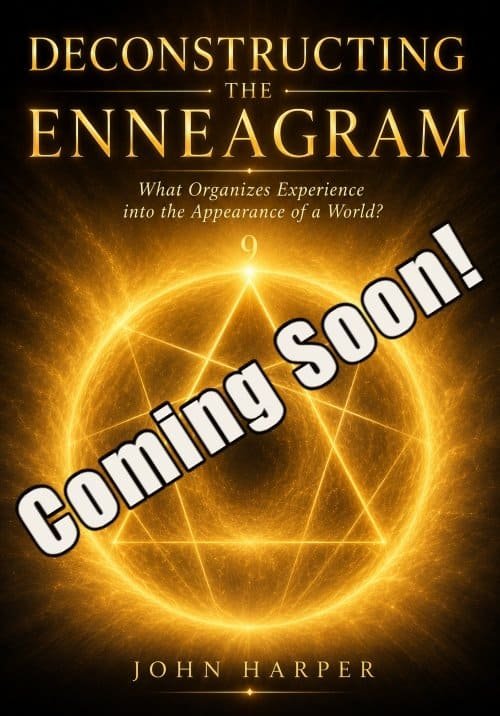
Deconstructing the Enneagram asks what remains when the familiar explanations of the symbol are temporarily set aside. It examines the Enneagram’s claimed history, the musical octave, the mathematics of the hexad, the later addition of personality types, and the assumptions that have accumulated around the symbol over time.
The book does not try to disprove the Enneagram. It shifts the basis of authority from inherited explanation to direct investigation. Instead of asking whether the symbol is ancient, mathematically elegant, or traditionally sanctioned, it asks whether its principles can actually be recognized in experience.
As the inquiry deepens, the circle, triangle, and hexad begin to suggest three distinct dimensions: field, force, and movement. Personality then appears not as the meaning of the symbol itself, but as one possible expression of a larger organizing process.
The book ultimately turns toward a more fundamental question: What organizes experience into the appearance of a coherent self and world? In that sense, deconstructing the Enneagram becomes less about dismantling a system and more about seeing the symbol freshly enough to ask what it may actually be pointing toward.
Frequently Asked Questions
“The symbol asks how experience becomes organized. Personality becomes one visible expression of that organization.”
Deconstructing the Enneagram begins by temporarily setting aside what generations of students have been taught the symbol means. It examines the Enneagram’s history, Gurdjieff’s claimed lineage, the musical octave, the mathematics of the hexad, the later addition of personality types, and finally several assumptions so deeply embedded in Enneagram teaching that they can be difficult to see. The investigation eventually moves beyond the question of personality and asks something larger: What organizes experience into the appearance of a self and a world?
The book deliberately distinguishes between what the historical record can establish and what remains possible. Its purpose is not to disprove the Enneagram, but to discover what remains when inherited explanations are no longer carrying the symbol’s authority.
Where did the Enneagram come from?
The exact historical origin of the Enneagram symbol remains unresolved. The book finds no verified source for the complete circle-triangle-hexad figure before G. I. Gurdjieff presented it in the early twentieth century. This does not prove that Gurdjieff created the symbol, because the absence of surviving evidence is not evidence of invention.
Gurdjieff maintained that important elements of his teaching came from much older schools encountered during his travels. Deconstructing the Enneagram takes that claim seriously while distinguishing it from historical verification. Ancient traditions certainly contain circles, triads, sevenfold structures, sacred mathematics, and teachings about process, but no verified pre-Gurdjieff source has been found for the particular nine-pointed Enneagram combining circle, triangle, and hexad has not been located in a verified pre-Gurdjieff source.
The book therefore shifts authority away from antiquity. The more important question becomes whether the symbol reveals something that can be observed directly.
What do we know about the origins of the Enneagram symbol?
We know much more about the Enneagram’s modern transmission than about its ultimate origin. We know that Gurdjieff presented the symbol, the Law of Three, and the Law of Seven to students in the West. What the historical record cannot presently establish is where the complete symbol existed before him.
The book also separates the ancient significance of the number seven from Gurdjieff’s specific Law of Seven. Seven appears throughout religious, mythological, astronomical, and contemplative traditions, but the specific model of seven-stage development, characteristic intervals, and required shocks has not been located in the ancient record examined by the book.
That uncertainty matters because an ancient origin is often treated as evidence for the truth of the teaching. Deconstructing the Enneagram proposes a different standard: Can the principles be recognized in experience regardless of who first formulated them?
Did Gurdjieff create the Enneagram or inherit it from an older tradition?
The book concludes that the available evidence cannot determine whether Gurdjieff created the Enneagram, inherited it, or synthesized older material into a new form. It keeps several possibilities open.
Gurdjieff may have received fragments from oral or esoteric traditions and organized them into his own formulation. He may have encountered a complete teaching for which no historical record survived, or he may have arrived at the underlying principles through his own investigation and expressed them using mathematical and musical forms available to him.
The book resists turning uncertainty into certainty in either direction. There is insufficient evidence to establish an ancient lineage, but the absence of evidence does not establish Gurdjieff as the inventor.
This unresolved provenance ultimately becomes part of the inquiry itself: if the teaching cannot depend upon an ancient pedigree for its authority, it has to stand on whether it describes something real.
Was there really a Sarmoung Brotherhood?
The Sarmoung Brotherhood has not been independently verified, and the book does not claim that this proves it never existed. Gurdjieff described the Brotherhood as an ancient repository of esoteric knowledge, but the manuscript notes that no archive, independent traveler’s account, or scholarly investigation has confirmed an institution matching his description.
The book then explores a more provocative possibility: what if the Sarmoung story functioned as teaching as much as history? Gurdjieff came from a storytelling culture and frequently used stories, paradox, exaggeration, and deliberate difficulty to work on the reader rather than simply inform the reader. The Brotherhood could therefore have been historical, symbolic, or some mixture of both.
The book ultimately refuses to make the historical question carry more weight than it can. Whether the Brotherhood existed or not, the teaching eventually has to stand on its own, without borrowed authority.
What does Gurdjieff have to do with the modern Enneagram of Personality?
Gurdjieff transmitted the Enneagram symbol to the West, but he did not teach the contemporary system of nine personality types. His teaching used the symbol primarily in relation to universal process, the Law of Three, the Law of Seven, and the interaction of forces.
The personality interpretation came later. According to the history presented in the book, Oscar Ichazo first associated specific psychological fixations with the nine points; Claudio Naranjo developed those associations into descriptions that became foundational to the modern personality Enneagram, and later teachers continued refining the system.
This distinction is fundamental to Deconstructing the Enneagram. The personality system may be extremely useful, but it is a later application of the symbol rather than the meaning inherently contained in the original geometry.
That opens the book’s central question: what does the symbol reveal when the personality interpretation is temporarily removed?
When were personality types added to the Enneagram?
They were added after Gurdjieff’s presentation of the symbol, through the work of Oscar Ichazo and then Claudio Naranjo. The manuscript itself does not assign a precise calendar year to that transition, so this FAQ does not manufacture one.
What matters for the book’s argument is the sequence. The circle, triangle, and hexad already existed as a complete figure before Ichazo associated particular psychological fixations with its nine points. Naranjo then developed those associations further, and subsequent teachers elaborated the system into the contemporary Enneagram of Personality.
Personality therefore entered an already-existing symbol. That does not invalidate the personality system; it changes the historical relationship between the psychology and the geometry.
Did Oscar Ichazo discover the nine personality fixations or assign them to the symbol?
The book argues that the historical record looks more like assignment than discovery, while giving Ichazo’s psychological observation considerable credit. Ichazo drew from multiple sources, including Sufi teachings, Kabbalah, Christian mysticism, and his own investigation. He worked out, elaborated, and later modified his mappings rather than receiving them unchanged from a demonstrably ancient source.
Yet Deconstructing the Enneagram does not dismiss what Ichazo saw. It describes his insight as remarkably precise: consciousness really does organize around characteristic domains of experience, and these organizations produce recognizable patterns.
The distinction is important. The patterns may be discoveries while their placement and interpretation within the symbol remain assignments.
That allows us to preserve the phenomenological accuracy of type descriptions without assuming that nine personality types were hidden inside the geometry waiting to be uncovered.
Why did Gurdjieff use the musical octave to explain the Law of Seven?
The musical octave gave Gurdjieff a vivid way to illustrate his claim that development does not proceed uniformly. In the familiar Western octave, the intervals between Mi-Fa and Si-Do differ from the larger intervals between most of the other notes. Gurdjieff used these places to illustrate points where a process loses ordinary momentum and requires an additional “shock” to continue in its original direction.
The analogy is powerful because it makes a difficult idea immediately perceptible. Instead of merely saying that processes encounter characteristic resistance, the teaching lets the student hear and visualize an uneven sequence.
Deconstructing the Enneagram, however, asks whether an effective illustration has gradually been mistaken for evidence. Music may illuminate the Law of Seven without being its foundation.
Does the Western musical scale really prove the Law of Seven?
No. One of the book’s opening arguments is that the Western musical scale cannot establish the Law of Seven as a universal law of reality. The familiar pattern depends upon a particular musical tradition and tuning history.
Indian classical music, for example, organizes pitch differently through shrutis, continuous glides, ragas, and the ever-present drone. The particular Mi-Fa and Si-Do geography that seems so self-evident on a Western keyboard does not function as a universal physical map across musical cultures.
This does not destroy the Law of Seven. It removes one argument for it.
What remains is the phenomenological observation that processes do appear to develop unevenly, encounter resistance, and sometimes require a qualitatively different input to continue. The law therefore has to be investigated in process itself, rather than proved by a piano keyboard.
Where does the sequence 1–4–2–8–5–7 come from?
The Enneagram’s hexad sequence comes from the repeating decimal produced by dividing one by seven: 1/7 = .142857142857… Placing the digits 1, 4, 2, 8, 5, and 7 around the nine-pointed circle and connecting them in that order generates the familiar hexad.
Unlike the musical explanation, this mathematical relationship does not depend upon a culture’s tuning system. The repeating sequence is the same wherever the calculation is performed.
This is one reason the mathematical basis of the hexad can seem more compelling than the octave analogy. Yet the book immediately raises another question: a repeating decimal is a numerical pattern. Why should that pattern describe the way actual processes unfold?
The mathematics explains where the sequence comes from. It does not, by itself, explain why the sequence should be a law of development.
Is the mathematics of the hexad evidence of a universal law?
The mathematics is universal, but the book argues that this alone does not prove that the hexad describes a universal law of process. The sequence 142857 genuinely follows from one-seventh. That mathematical fact requires no esoteric interpretation.
The interpretive step occurs when the mathematical sequence is said to describe how real processes unfold through time. Mathematics itself does not make that claim; a human interpreter does.
The book therefore treats the mathematics as a powerful pointer, not as proof. Perhaps mathematical pattern and living process both express some deeper organizing principle. That is possible, and it may be precisely what the hexad reveals. But that relationship must be investigated phenomenologically and experientially, not assumed because the numbers are elegant.
What remains of the Law of Seven when the musical explanation is removed?
What remains is the observation that development is uneven, structured, and subject to characteristic thresholds where continuation may require something qualitatively different from what brought the process that far. This is the part of the Law of Seven the book continues to take seriously.
A writer can reach a place where more effort does not produce the next movement. A therapeutic process can reach a threshold that insight alone cannot cross. A developmental process can encounter resistance requiring surrender, receptivity, new information, or another form of participation.
The musical scale no longer proves where those intervals must occur, and the mathematics does not explain why they exist. The Law of Seven becomes a proposition about the phenomenological topology of development.
Its authority therefore shifts from inherited explanation toward observation: does actual process behave this way?
What does the circle mean before personality is placed upon it?
In the book’s reconstruction, the circle represents the field or totality within which every differentiation, force, position, and movement occurs. It is not simply a decorative border holding nine personality numbers.
The circle is drawn first. It has no privileged point, no beginning preserved within the completed form, and no place outside itself supplied by the geometry. It simultaneously suggests wholeness and continuous movement.
This leads the book toward a different reading: the circle as a field with no external position, a ground that is not hidden behind experience but present as the very context within which experience occurs.
The nine points can then be read not primarily as nine separate kinds of people, but as nine directions or terrains emerging within one field. All nine arise from the same unmarked center.
Why are the circle, triangle, and hexad three separate geometrical figures?
The book argues that the three figures represent three irreducible dimensions: field, force, and movement. They occupy one drawing without collapsing into one another.
The circle establishes the whole field. The equilateral triangle at 9-3-6 depicts three co-emergent forces, none prior to the others. The hexad follows its asymmetric mathematical sequence through 1-4-2-8-5-7 and depicts lawful movement or process.
A striking feature of the geometry is that the triangle and hexad never share a point. Together they account for all nine points, yet their internal logics remain entirely different. The triangle is symmetric; the hexad is asymmetric. One arises geometrically; the other mathematically.
The book calls this orthogonality: three dimensions simultaneously present, each complete in its own terms. Process does not “move through” the forces as though they were stages. The forces are dimensions within which movement occurs.
What if the symbol is describing field, force, and process rather than nine kinds of people?
That possibility becomes the book’s central rereading of the Enneagram. Remove the personality overlay temporarily, and three things remain: a circle suggesting totality, a triangle suggesting triadic organization, and a hexad suggesting lawful movement.
From that perspective, personality becomes one phenomenon that can be understood through the symbol rather than the subject the symbol was originally designed to describe.
The nine points then become terrains or domains of experience. Everyone moves through all of them. A type develops when movement becomes so habitually organized around a particular terrain that its recurring weather begins to be experienced as identity. The accuracy of personality descriptions is preserved; what changes is their ontological status.
A type becomes less “what I am” and more where experience has learned to linger.
What is process?
In the framework developed by the book, process is the unfolding of organization through time within a field that the movement never actually leaves. It is observable whenever something arises, develops, changes direction, encounters resistance, receives new influence, reorganizes, and continues.
Process is therefore different from a static object moving through a sequence of predetermined compartments. Real processes loop, return, cross previous territory, deepen, stall, renew, and sometimes arrive somewhere new by apparently moving backward. The hexad’s asymmetric geometry becomes evocative precisely because actual development so often behaves this way.
Yet the Law of Seven does not finally explain process. It describes something about its topology. The circle introduces the prior question: What is the field within which process occurs, and how can movement arise without ever departing from its ground?
What makes a process lawful rather than arbitrary?
A process is lawful, in the sense investigated by the book, when its unfolding exhibits recurring structure rather than being merely random or dependent upon personal preference. The Law of Seven claims that development encounters characteristic intervals and that different qualities become necessary at those intervals.
The hexad gives a geometrical representation of this possibility, but the book refuses to treat the drawing as proof of the claim. A symbol can encode a proposition without proving that the proposition describes reality.
The important test is observation. Do creative processes, developmental processes, relationships, learning, therapy, contemplative practice, and other unfolding phenomena exhibit recurring thresholds where ordinary momentum becomes insufficient? If so, the Law of Seven may be naming something structurally real.
The lawfulness must ultimately be found in the territory, not granted merely because the map is elegant.
Does organization require an organizer?
No. One of the book’s central investigations is whether genuine organization can arise without a separate entity directing it. The murmuration of starlings provides the primary analogy.
Thousands of birds can turn together with extraordinary coherence even though no bird possesses the plan of the whole formation and no hidden conductor directs the movement. Each bird responds locally to neighboring birds; the global pattern emerges from those relationships. The organization is real even though the organizer disappears.
The book then applies this question to personality. Thoughts, emotions, attentional habits, bodily reactions, memories, and interpretations may mutually reinforce one another in much the same way. Their coordination can produce a stable and recognizable personality pattern without requiring a separate hidden entity directing it.
Order may belong to relationship and responsiveness themselves rather than to an orderer standing behind them.
What actually persists in a personality pattern?
What may persist is the pattern’s recurring organization rather than a fixed psychological object stored somewhere inside the person. This is one of the book’s most important deconstructions.
A friend can recognize the same characteristic gesture, reaction, silence, humor, or emotional movement twenty years later. The continuity is real. The book questions the inference that such continuity requires a permanent internal structure producing each recurrence.
The river provides the analogy. We recognize the same river even though its water is continually changing. Its continuity belongs to the organization of flow.
Likewise, personality may persist because the same relational pattern continually reassembles. Its remarkable stability can be the steadiness of an ongoing process rather than the immobility of an object.
Is there really a fixed thing called a fixation?
The book does not claim to prove that fixation does not exist; it shows that direct investigation fails to find fixation as a separate thing behind its expressions. What can actually be found are thoughts, contractions, emotional movements, attentional habits, interpretations, memories, impulses, and behaviors.
When attention looks behind those activities for the entity supposedly organizing them, it repeatedly finds more activity.
This leads to a different possibility: perhaps fixation is not the hidden choreographer of the pattern. Perhaps fixation is the constellation itself in motion, maintaining coherence because its elements continually respond to and reinforce one another.
Later, the book reframes type still further as a “habit of place”: a living process repeatedly circling a particular terrain until the weather of that terrain comes to look like the person’s permanent identity.
What organizes experience into the appearance of a coherent self?
The book gradually withdraws the assumption that a separate self must organize experience and instead examines how the sense of ownership is already built into experience itself. A memory appears already my memory. A thought appears already my thought. Ownership does not seem to be applied after the experience arises; the two arrive together.
When the book then searches directly for the owner, every candidate becomes something observable: a face, name, history, body sensation, self-image, autobiographical story, or thought about “the kind of person I am.” Each answer to Who is looking? becomes another thing looked at.
The inquiry therefore does not discover a hidden psychological controller. Experience continues while the supposed proprietor remains unaccounted for.
The result is less a new theory of self than a change of question: What if coherent selfhood is an activity of organization rather than evidence of an independently existing organizer?
What organizes experience into the appearance of a world?
The book does not answer this by proposing another hidden mechanism. Instead, it turns attention toward the field in which every proposed explanation of the world itself appears. Neuroscience, psychology, metaphysics, memory, sensory experience, and even theories explaining awareness through the brain all arrive as experiences within awareness.
This does not mean the book claims neuroscience is false or that the physical world is unreal. It makes a narrower phenomenological point: we cannot step outside experience to inspect an alleged machinery existing completely apart from experience. Even evidence for such machinery is encountered within the field being explained.
The apparent division between an inner representation and an unknowable outer mechanism is therefore itself something appearing within experience. The inquiry closes the imagined distance between observer and observed.
The Enneagram then becomes relevant in a very different way: the circle as field, the triangle as co-emergent organizing forces, the hexad as movement. It becomes a possible diagram of how organization appears, not merely how personality behaves.
What is the Enneagram pointing toward?
The book ultimately proposes that the Enneagram points toward the organization of experience itself: an undivided field, co-emergent forces, lawful movement, and differentiated terrains arising within one ground. Personality is one visible expression of that larger process.
The circle points toward the field that has no position outside itself. The triangle depicts three forces arising together rather than sequentially. The hexad depicts movement with its asymmetric, recurring, nonlinear rhythm. The nine points become terrains through which the movement expresses itself rather than nine separate species of human being.
Even this reading, however, is not allowed to become another doctrine. The book warns that any interpretation of the symbol remains an interpretation, another appearance within the field. The drawing is not finally “explained.” It is encountered more directly.
That may be the book’s deepest deconstruction. The question ceases to be simply “What does the Enneagram mean?” and becomes: What is happening here, in experience, that caused someone to draw a circle, a triangle, and a hexad in the first place?