
Is this just another Enneagram personality site?
No. This site begins where most Enneagram of Personality work tends to stop.
The Enneagram of Personality can help you identify your type, understand motivations and defenses, improve relationships, and become more conscious of habitual patterns. That work has real value. But it still leaves deeper questions unanswered:
Why does personality remain so persistent even when we understand it?
What does the Enneagram reveal about how transformation happens?
The work here investigates personality as part of a larger process:
How experience becomes organized, how perception and the nervous system help sustain recurring patterns, how mechanical repetition develops, where shock and presence enter the process, and how transformation involves more than improving the personality we already know.
If you are interested in how personality forms, why it repeats, and how the Enneagram can function as a map of transformation, this is the question this site is built around.
FROM PERSONALITY TO PROCESS
Psychological change changes the contents and functioning of personality. Transformation changes our identification with personality.
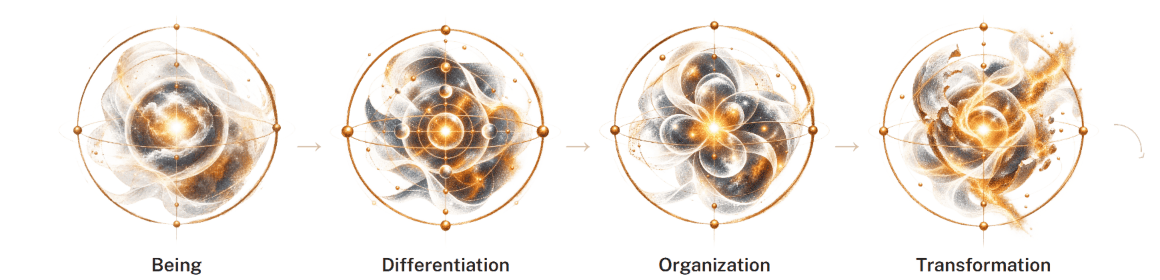
For the Enneagram of Personality, transformation is largely change within personality and its relationships. For Enneagram as Process, transformation is a change in what the person takes themselves to be.
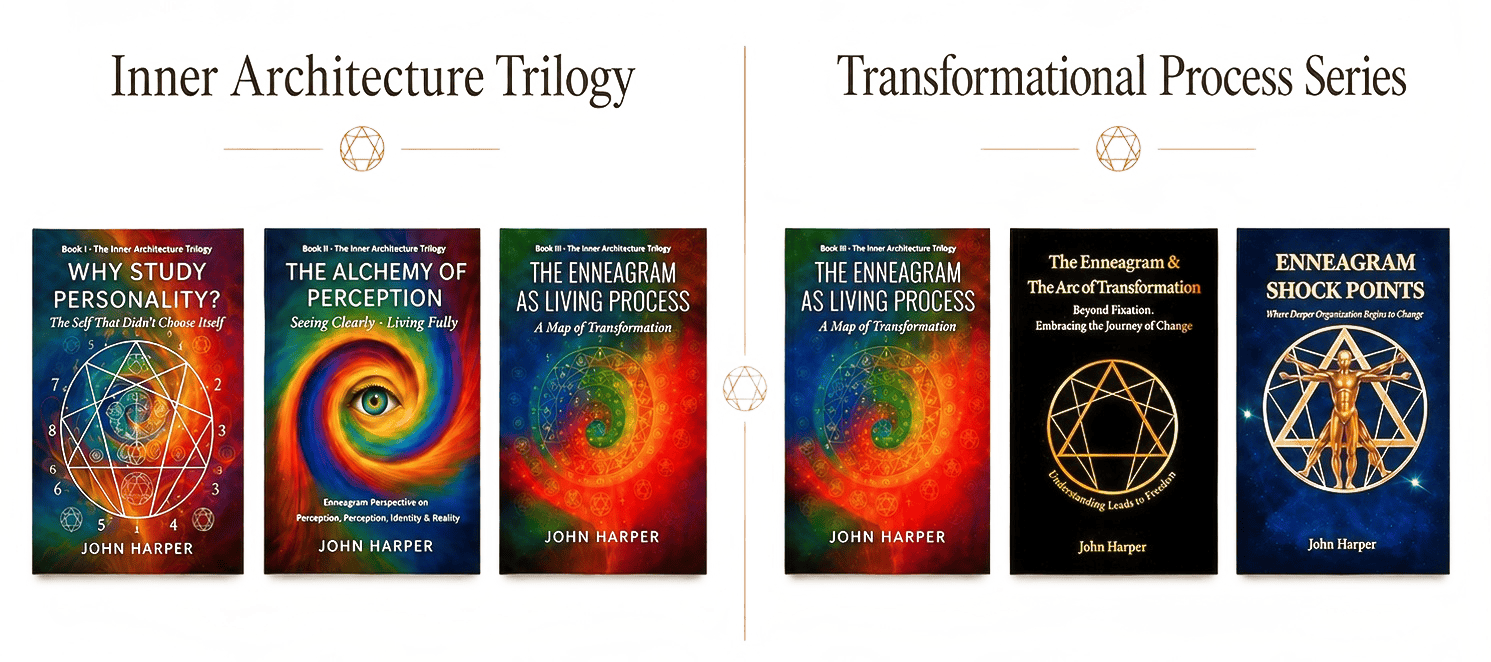
The Inner Architecture Trilogy explores how personality is formed, how perception is shaped, and how the Enneagram reveals the underlying organization of human experience. The Transformational Process Series builds on that foundation by tracing the lawful movement through which personality can be understood, loosened, and ultimately transformed. Together, these books move from the structure of experience to the process of awakening within it.
Explore the BooksEnneagram of Personality
Type → traits & motivations → pattern recognition → self-observation → growth/stress dynamics → behavioral change → healthier personality
Enneagram as Process
Process → organization → perception → personality → mechanical repetition → shock → transformation
FROM READERS
What Readers Are Saying
“I have read the Trilogy and am now in the middle of The Enneagram & The Arc of Transformation. What gifts! I cannot speak highly enough of these books and am spreading the word among my friends in the worlds of the Enneagram, Diamond Approach, and Gurdjieff.”
Joyce
“I have been an Enneagram student since 1995, studying with Helen Palmer and David Daniels, and later with Don Riso and Russ Hudson. A longtime friend recommended your book, and I am completely engrossed in it. Thank you for your deep thinking on the structure of the symbol and your remarkable insights.”
Ruth
“Thanks for this, John. I am currently reading your book (The Enneagram & The Arc of Transformation) and finding it transformative. I am a Diamond Approach student and have recommended this article (The Enneagram as Living Process: The Longing of the Divine to Be Known) and your book to others in the group.”
Tony

Your Nervous System Is a Tangled Ball of Yarn
September 22, 2026
As metaphors go, this image may be a pretty good way to describe the situation. Your nervous system is something like a tangled ball of yarn. Some strands are pulled tight, some loop around others, some disappear into knots, and some connect what is happening now with experiences that occurred decades ago. You may have
Read the Note →
The Enneagram is Orthogonal
September 13, 2026
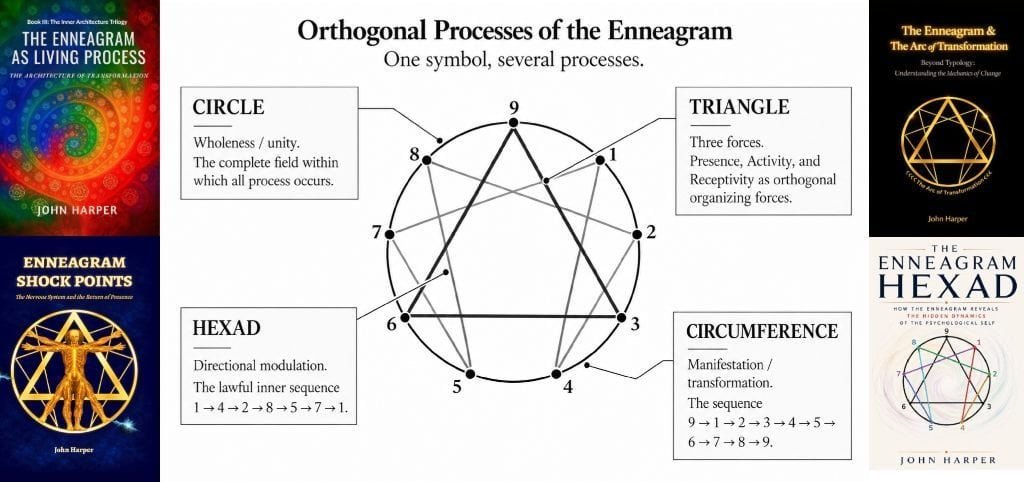
Personality is the Face of Process Describing the Enneagram symbol as orthogonal means that its distinct geometric components and functional layers intersect like independent axes on a coordinate grid. Rather than flattening the symbol into a single personality taxonomy, an orthogonal perspective recognizes that multiple distinct processes operate simultaneously on different dimensions without collapsing into
Read the Note →

We Are All Nine Types
August 30, 2026
Why “we are all nine types” confuses wholeness with typology, and how the Enneagram becomes clearer when type is understood as one recurring organization within a larger living process.
Read the Note →