What does The Enneagram as Living Process help me understand?
Most Enneagram teaching begins with the nine personality types. This book begins with the symbol itself and asks a different question: What does the Enneagram reveal about how consciousness moves, becomes organized, encounters interruption, and turns into the patterns we later call personality?
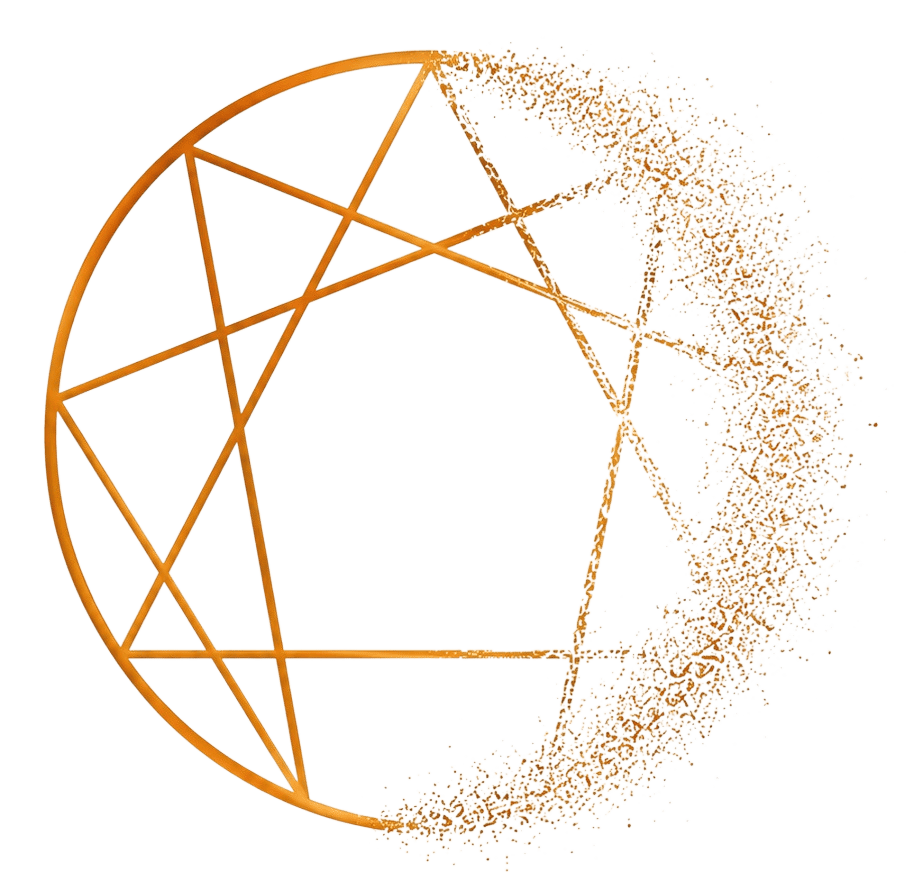
The Enneagram as Living Process approaches the circle, triangle, hexad, and shock points as parts of one living mechanism. The triangle expresses the three fundamental forces of awareness, action, and receptivity; the hexad shows the lawful movement of process; and the shock points identify the places where momentum alone is insufficient and a new quality must enter if the process is to continue rather than repeat mechanically.
From this perspective, personality is not the foundation of the Enneagram. It is what can happen when a living process becomes interrupted, repeated, and eventually experienced as identity. The book therefore uses type as an application of the deeper architecture rather than as the meaning of the symbol itself.
The aim is to help you recognize where flow becomes fixation, how the shock points function in lived experience, and how awareness can re-enter the process so that mechanical repetition becomes responsive movement again. The Enneagram becomes less a map of nine kinds of people and more a map of how consciousness forgets itself through identification and returns through presence.
Frequently Asked Questions
“The question is not whether you have a pattern. Everyone does. The question is whether you are the pattern or the awareness that can see it.”
The Enneagram as Living Process shifts the starting point of Enneagram study from nine personality types to the symbol itself. In this approach, personality remains important, but it becomes one expression of a deeper architecture involving wholeness, force, movement, interruption, and renewal. The circle, triangle, and hexad describe different dimensions of that architecture, while the nine types show how the living process can become organized into recurring patterns of identity.
What is the Enneagram symbol mapping?
The Enneagram is fundamentally a map of process: how something arises, develops, encounters resistance, receives new influence, and completes its movement. In The Enneagram as Living Process, the symbol is approached first as a dynamic structure rather than as a diagram of nine kinds of people.
Its three geometrical elements contribute different dimensions. The circle represents the whole field through which a process unfolds. The triangle represents three fundamental forces: awareness, action, and receptivity. The hexad shows the lawful, uneven movement of energy through time. Considered together, the symbol describes the mechanics of becoming rather than simply the characteristics of personality.
Personality then becomes one application of this larger process: what happens when the movement of consciousness becomes interrupted, repeated, and eventually experienced as identity.
Was the Enneagram originally a personality typing system?
No. The Enneagram symbol predates its modern use as a system of nine personality types. In the framework presented in this book, the Enneagram transmitted through G. I. Gurdjieff was a process-symbol concerned with movement, transformation, the Law of Three, the Law of Seven, and the places where a process requires renewed input.
The modern personality Enneagram is therefore treated as a valuable later application rather than the symbol’s foundation. Personality typing identifies recognizable patterns of adaptation, but the underlying geometry addresses a broader question: how does a process unfold, and what happens when its movement is interrupted?
This distinction does not require abandoning type. It places type inside a larger architecture.
Can the Enneagram be understood as a map of process rather than personality?
Yes. That is the central premise of The Enneagram as Living Process. Instead of beginning with nine types and interpreting the symbol through them, the book begins with the circle, triangle, hexad, and the movements they represent. Personality is then understood as one crystallization of those deeper dynamics.
This reverses the usual order of study. The Enneagram of Personality asks, “What type am I, and how does my type function?” A process orientation asks, “What is moving here? What forces are operating? Where has movement become repetitive? Where does awareness need to enter?”
The personality system is therefore recontextualized rather than rejected. Type becomes a way of seeing how an organism has adapted to more fundamental relational, instinctual, emotional, and energetic forces.
What does the circle represent?
The circle represents wholeness: the complete field of Being within which every process begins, unfolds, and returns. It is continuous, without a break, and therefore symbolizes both origin and completion.
Moving around its circumference, the book traces an arc in which intention arises, reaches toward relationship, becomes action, turns toward self-awareness, develops understanding, encounters uncertainty, opens into possibility, becomes embodied, and returns to stillness. Point Nine completes the movement and simultaneously provides the ground from which another cycle can begin.
The circle is also fractal in this model. A breath, conversation, relationship, creative project, developmental process, or lifetime can contain the same general rhythm. Personality represents a smaller repetitive orbit occurring within this larger field, a place where the total movement has narrowed into habitual repetition.
What does the triangle represent?
The inner triangle represents three fundamental forces required for any process: awareness, action, and receptivity. These are associated with Points Nine, Three, and Six.
Point Nine represents awareness or Presence, the field capable of holding movement without becoming identical to it. Point Three represents active force, manifestation, expression, and doing. Point Six represents receptivity, openness, and the capacity to receive what effort alone cannot produce.
These are not merely traits belonging to Types Nine, Three, and Six. The book treats them as forces operating in everyone and in every process. Any creative act, relationship, conversation, breath, or inner movement contains some interplay of expression, receiving, and the field that holds both.
The triangle therefore describes how movement becomes possible, while the hexad describes how that movement unfolds through time.
What does the hexad represent?
The hexad represents the lawful movement of a process through time. Its six points connect in the sequence 1 → 4 → 2 → 8 → 5 → 7 → 1, revealing that development does not simply move in a smooth progression around the circumference of the circle.
The book describes the hexad as the hidden rhythm beneath the visible process. Energy changes direction, density, and quality as it unfolds. There are accelerations, contractions, pauses, and renewals. The process has an internal topology.
If the triangle provides the three forces necessary for movement, the hexad provides the pathway through which those forces become actual process. The book uses the analogy of an engine and transmission: the triangle makes movement possible; the hexad channels that movement into a specific sequence.
What is the Law of Three?
The Law of Three proposes that every phenomenon arises through the interaction of three forces rather than through a simple opposition of two. These are traditionally described as active, receptive or resisting, and reconciling forces.
In this book, the three forces are expressed phenomenologically as action, receptivity, and awareness. Something moves outward into expression, something receives or absorbs, and something holds or reconciles the relationship between them. The inner triangle at 3–6–9 represents this threefold dynamic.
The third force matters because opposites alone tend to remain locked in opposition. Action without receptivity becomes compulsion. Receptivity without action can become passivity. Awareness provides the ground in which both can participate in a larger movement.
The Law of Three therefore concerns the forces that make manifestation possible.
What is the Law of Seven?
The Law of Seven describes the uneven rhythm through which a process develops, including characteristic places where momentum alone cannot carry it forward. A process does not progress uniformly from beginning to completion. It changes quality along the way and encounters intervals where something new must enter.
The Enneagram’s hexad depicts this pattern. In the traditional musical analogy, an octave contains two intervals where the spacing changes. The book associates these with the Enneagram’s two shock points, between 3 and 4 and between 6 and 7.
The deeper significance of the Law of Seven is practical. It helps explain why effort that worked earlier in a process may suddenly stop working. At certain thresholds, simply doing more of the same cannot produce continuation. A different quality of attention, receptivity, or presence is required.
Why does the hexad follow 1–4–2–8–5–7?
The sequence 1–4–2–8–5–7 expresses the Enneagram’s internal pattern of movement rather than a conventional step-by-step progression around the circle. In the book, these movements are treated as lawful shifts in direction and density within a process.
The hexad does not proceed 1–2–3–4–5–6–7–8–9. Instead, it leaps from 1 to 4, from 4 to 2, then through 8, 5, and 7 before returning to 1. The book relates this sequence to the mathematical and musical structure traditionally associated with the Law of Seven, using it to illustrate that living processes move through changing intervals rather than a straight line.
The significance is less about memorizing the numbers than recognizing what the geometry suggests: process has an internal rhythm that is not visible from the outer sequence alone.
What are the shock points in the Enneagram?
The two shock points are the intervals between Points 3 and 4 and between Points 6 and 7, where the existing momentum of a process is insufficient and a new quality must enter. In The Enneagram as Living Process, these are not abstract positions on a diagram. They are moments that can be recognized in lived experience.
At the first shock point, outward activity reaches a threshold and turns toward self-awareness. Without Presence, the movement can collapse into self-consciousness, self-image, and identification. With awareness, the same interval becomes an opportunity to recognize experience without becoming defined by it.
At the second shock point, understanding and effort reach their limit. Without openness, the process falls back into anxiety, planning, escape, or repetition. With receptivity, something fresh can enter and renew the movement.
The shock points are therefore the places where repetition and transformation diverge.
What do the arrows signify?
In this book, the connecting lines are understood primarily as relationships of resonance within one field rather than as routes along which a person literally moves from one personality type to another. A type can become more permeable to qualities represented by connected points without ceasing to be its own pattern.
For example, an Eight becoming more present does not literally “become a Two.” Rather, as defensive organization softens, love, tenderness, and attunement associated with Two can enter the Eight’s field without eliminating strength. The field becomes more inclusive and less rigid.
This changes the meaning of integration. Integration becomes less about traveling around the diagram and more about releasing the boundaries that prevented other qualities of Being from being available.
Do the arrows mean that we become another personality type under stress or growth?
No. In the framework of The Enneagram as Living Process, movement along a connecting line does not mean that your core personality type temporarily changes into another type. What changes is the quality of your organization and which qualities become available within it.
Under contraction, a pattern may resonate with defensive characteristics represented elsewhere in the symbol. Under Presence, it may become receptive to essential qualities previously excluded. The pattern does not physically relocate on the Enneagram.
The Eight-to-Two example makes this explicit: an Eight under Presence remains an Eight in its characteristic expression, while tenderness and attunement can permeate strength. As the process deepens, more of the circle becomes available and the boundaries separating one point from another become increasingly transparent.
Integration therefore means increasing wholeness, not changing one’s number.
How does personality form within the larger Enneagram process?
Personality forms when a larger living process becomes interrupted, and a particular adaptive organization begins repeating itself. The book describes type as a crystallization rather than as the starting point of human experience.
At deeper levels, forces, instincts, object relations, emotions, temperament, and environmental responses are already interacting. One movement may become habitual, one center may become dominant, and one’s relationship to another capacity may become strained. Through repetition, this organization stabilizes and eventually becomes experienced as “me.”
This is why the nine types are described as nine variations of a single event rather than nine fundamentally separate kinds of human beings. Each represents a particular way the organism keeps functioning when the larger flow of experience has become interrupted. Personality is thus an intelligent adaptation within process, not the origin of process itself.
Are instincts deeper than personality type?
Yes, in the architecture of this book, the instincts are more fundamental than personality type because they are biological currents operating before personality becomes organized. Every person participates in the social, sexual, and self-preservation instincts regardless of Enneagram type.
The book connects the social instinct with emergence into relationship and the collective field, the sexual instinct with movement toward depth, fusion, and intimate contact, and self-preservation with continuity, nourishment, stability, and embodiment. These instincts do not belong exclusively to Types Three, Six, or Nine. Rather, those points illuminate different underlying movements with which the instincts correspond.
Personality subsequently organizes around these biological, relational, and emotional movements. The instincts themselves are not viewed as distortions; distortion occurs when these natural currents become narrowed, exaggerated, defended, or recruited into egoic adaptation.
How do the three centers relate to the triangle at 3, 6, and 9?
The three centers and the 3–6–9 triangle are related, but they are not the same structure. This distinction is important in The Enneagram as Living Process.
The head, heart, and belly centers are modes of human intelligence: conceptual and representational intelligence, emotional and relational intelligence, and instinctual and orienting intelligence. These capacities exist independently of the Enneagram symbol.
Points 3, 6, and 9, meanwhile, form a structural triangle describing how experience moves: outward expression, receptive or counter movement, and settling or awareness. Traditional type teaching associates 3 with the heart, 6 with the head, and 9 with the belly, but the book interprets those locations diagnostically: they indicate places where connection with a center becomes conflicted, rather than claiming that the center originates at that point.
The centers describe forms of intelligence. The triangle describes forces and movement.
What does it mean to say that type is an interruption in a larger process?
It means that personality is understood as a place where an originally fluid movement became repetitive, stabilized, and eventually experienced as identity. The process itself did not disappear. Its movement narrowed into a smaller, self-reinforcing orbit.
The book describes personality as a “frozen moment within a larger process.” When awareness fails to enter at a critical threshold, the organism finds another way to maintain continuity. That adaptation is intelligent and necessary, but repetition gradually turns the adaptation into fixation.
From this perspective, transformation is not primarily about attacking the fixation or building a superior personality. It involves bringing awareness back to the places where the process became interrupted. As those places become conscious, movement that had been cycling mechanically can begin flowing again.
This is why the same pattern that reveals where consciousness contracted can also reveal the pathway of return.
How can the same Enneagram symbol describe both personality and transformation?
Because personality and transformation can be understood as two different conditions of the same underlying process. The geometry does not need to change. What changes is whether the movement is occurring mechanically through identification or consciously through Presence.
When awareness is absent, the process contracts into repetition. Adaptive strategies become fixed, identity hardens, and consciousness repeatedly organizes experience through the same familiar pattern. When awareness enters at the critical intervals, the same architecture can become a pathway of renewal.
This is why the book describes the nine types as nine variations of one living process. The content of each personality differs, while the deeper structure is shared: movement, interruption, adaptation, recognition, opening, renewal, and return.
The Enneagram therefore does not need one diagram for personality and another for transformation. The same symbol can show what happens when Being forgets itself through organization and what happens when that organization becomes transparent enough for Being to remember itself.