Why doesn’t insight always produce change?
Understanding a pattern is not the same as changing the organization that sustains it. A person can recognize their Enneagram type, understand its defenses, trace its childhood origins, and see its recurring emotional patterns with great clarity, yet still find the same reactions returning under pressure.
The missing bridge is often somatic. Personality is not maintained only through ideas and beliefs; it is also embedded in automatic nervous-system responses, bodily contraction, emotional charge, and pre-verbal strategies for maintaining safety and connection. Without contact with that deeper organization, insight can remain conceptual rather than transformative.

Why the nervous system matters in Enneagram work
Personality is not maintained only through ideas, beliefs, and self-image. It is also expressed through the body: patterns of tension, bracing, withdrawal, mobilization, collapse, vigilance, and emotional charge can become deeply familiar long before we can explain them psychologically.
This means insight alone may not be enough. A person can understand their Enneagram type, recognize its defenses, and see the pattern clearly while the nervous system continues to respond through the same automatic pathways. Under pressure, the body may still contract, prepare for threat, shut down, or move into habitual strategies before conscious choice has much opportunity to intervene.
Enneagram work becomes deeper when attention includes this pre-verbal level of organization. Learning to track bodily contraction, affect, activation, and settling in real time can reveal where the pattern is actually being maintained. As the nervous system develops more capacity to remain present without immediately relying on familiar defenses, the personality structure can become less compulsory and more transparent.
Can trying to transcend your type become spiritual bypassing?
Yes. The desire to “get beyond” an Enneagram type can sometimes come from a genuine movement toward freedom, but it can also be driven by shame, frustration, exhaustion, or rejection of painful aspects of personality. In that case, transcendence can become a way to escape the pattern rather than understand it.
Spiritual bypassing happens when ideas such as presence, Being, non-identification, or awakening are used to avoid unresolved psychological material. Childhood adaptations, defenses, relational wounds, emotional reactivity, and nervous-system patterns do not disappear simply because we adopt a more spiritual understanding of ourselves.
For this reason, deeper transformation does not require us to reject personality. It requires that personality be understood, felt, regulated, and integrated well enough that it no longer has to be defended or escaped. The movement beyond identification becomes more genuine when it grows through the personality structure rather than around it.
Why psychological work still matters
Psychological work matters because personality is not simply an idea we can step outside of once we understand it. It is an adaptive organization shaped through relationship, defense, emotion, memory, and nervous-system regulation. Those structures need to be understood and worked through, not dismissed in the name of transcendence.
Becoming more aware of fixation, loosening defenses, healing relational patterns, developing emotional regulation, and gaining greater freedom from automatic reactions can profoundly change a life. This work creates more capacity, more openness, and less compulsion in the personality structure.
From the perspective of Enneagram as Process, psychological development is not the opposite of transformation. It is often the preparation that makes deeper transformation possible. As personality becomes more integrated and less defensive, it can function more freely without needing to remain the unquestioned center of identity.
How does the Enneagram symbol help transformation?
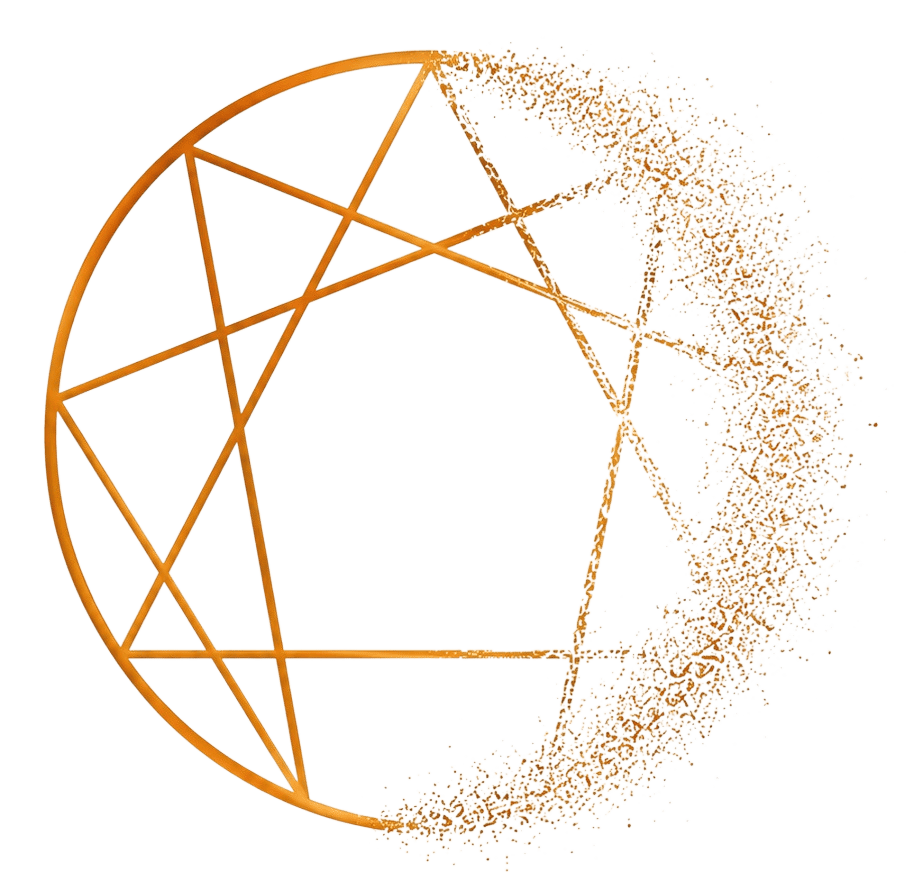
The Enneagram symbol helps by showing that transformation is not simply a matter of trying harder or choosing a better response. The circle, triangle, inner lines, and shock points describe a process with its own structure, movement, and places where automatic momentum can either continue or be interrupted.
From this perspective, the symbol becomes a living map rather than a static typing diagram. It can help us see how habitual patterns are sustained through recurring relationships among forces, how one phase of a process leads to another, and where presence or new influence must enter if the process is not to continue mechanically.
This is what gives the geometry practical value. The symbol does not transform us by itself, but it can reveal where a process repeats, where it loses energy, and where conscious participation becomes necessary. In that sense, the Enneagram becomes a map for recognizing the mechanics of transformation rather than merely describing the personality that needs to change.
Why are shock points important?
Shock points are important because processes do not always continue smoothly on their own. At certain intervals, the existing momentum is insufficient to carry the process forward in the same way. Without new influence, the process can lose energy, distort, or fall back into familiar mechanical patterns.
In Enneagram as Process, shock points identify places where presence, awareness, or deliberate participation can enter. They show where transformation requires something more than the continuation of habit. The process needs an additional influence if it is to move beyond repetition.
This makes shock points practically important. They help identify where automatic organization is most likely to reassert itself and where conscious participation can alter the course of development. Rather than treating transformation as a general intention, the Enneagram points toward specific moments where intervention matters.
Enneagram as Process
The Missing Bridge
What practice turns insight into real transformation?
Shift of identity from personality to Being
Somatic regulation and capacity for presence
Can I outgrow or get beyond my type?
Personality as an adaptive organization in consciousness
Deep psychological integration rather than bypassing
What do the arrows, Laws, and shock points mean?
The Enneagram as a map of unfolding process
Precise use of the symbol’s geometry
How do I get from ordinary type language to deeper work?
More precise psychological and ontological understanding
A gradual bridge from familiar experience into process
What this adds to Enneagram work
Much of contemporary Enneagram work is excellent at helping people recognize type patterns, understand motivations, identify defenses, and become more conscious of habitual reactions. What is often less developed is the bridge between understanding the pattern and changing the organization that keeps the pattern in place.
That bridge includes the body and nervous system, the capacity to remain present with charge and contraction, the psychological work needed to avoid bypassing, and a more precise use of the Enneagram symbol as a map of process rather than only a map of personality. These are the areas that help explain why insight can be profound and still leave the underlying pattern largely intact.
For the individual, this means the Enneagram can become more than a system for understanding yourself. It can become a way of recognizing where automatic organization is actually happening, what keeps it in place, and where conscious participation becomes possible. The aim is not simply to know your type more accurately, but to develop the capacity to experience the pattern without being completely governed by it.
For the Enneagram community, this fills an important gap between personality description and transformation. It connects psychological insight, somatic regulation, nervous-system capacity, the geometry of the symbol, and the shift from identification with personality toward presence. The result is a more complete account of how transformation actually happens, not just what transformation is supposed to look like.
The books on this site approach the Enneagram as a map of transformation, not simply a system for improving personality.
Together, they trace how personality is formed, how perception and nervous-system organization sustain it, how the Enneagram symbol maps process and interruption, and how transformation involves a shift in identity rather than merely becoming a healthier version of the same structure.
The aim is a more comprehensive understanding of the Enneagram: not just how personality can change, but how consciousness can become less identified with personality and more available to presence, Being, and a different order of experience.