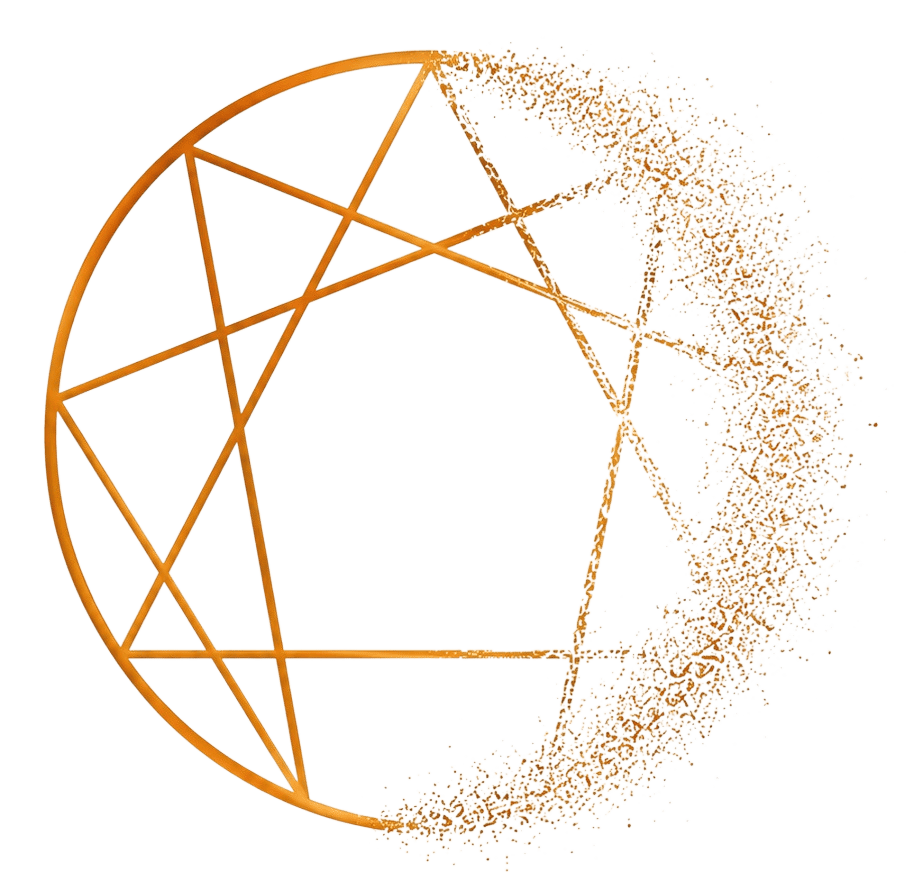
What Is the Enneagram Symbol Mapping?
The Enneagram symbol can be approached as more than a diagram for locating nine personality types. Its circle, triangle, and six-point movement raise a more fundamental question: how does something arise, become organized, move through a process, encounter interruption, and continue toward completion?
Seen this way, the symbol is a map of organization and process. Personality is one application of that architecture, but it is not the Enneagram’s whole meaning. The symbol points toward a larger investigation into force, movement, repetition, interruption, consciousness, and transformation.
Was the Enneagram originally a personality system?
No. The Enneagram symbol existed in modern teaching before it was connected to the nine personality types. Gurdjieff presented the symbol as a representation of process and lawful movement, not as a typology of nine kinds of people. The personality system developed later through the work of figures such as Oscar Ichazo and Claudio Naranjo.
That distinction matters because personality typing can easily become mistaken for the Enneagram itself. If we temporarily remove the types, labels, wings, subtypes, and psychological descriptions, the geometry remains: a circle, a triangle, and a six-point figure connected in a particular sequence.
The deeper question is therefore not simply, “Which number am I?” It is, “What kind of process requires this particular geometry?” That question opens the symbol beyond personality and returns attention to what it may actually be mapping.
What is the original Enneagram symbol?
The original Enneagram symbol is the geometric figure itself: a circle containing nine points, an inner triangle connecting 9, 3, and 6, and a six-point figure connecting 1, 4, 2, 8, 5, and 7. Before it became widely known as a personality system, the symbol was presented as a way of representing process, relationship, and lawful movement.
This is important because the nine personality types are not the symbol itself. They are a later application placed onto the nine points. If the type names, wings, subtypes, and personality descriptions are removed, the geometry remains and still asks to be understood on its own terms.
What do the lines in the Enneagram mean?
The lines in the Enneagram show that the symbol is describing movement, not simply nine separate positions. They connect the points in two distinct figures: the triangle joining 9, 3, and 6, and the six-point figure connecting 1, 4, 2, 8, 5, and 7.
In the modern Enneagram of Personality, these lines are often interpreted through ideas such as stress, security, integration, and growth. Those interpretations apply the lines to personality. They do not exhaust what the geometry itself may be expressing.
When the Enneagram is viewed as a process symbol, the lines indicate how movement proceeds through an organized sequence. One condition leads to another, the process changes as it moves, and the relationships among the points matter as much as the points themselves. The lines therefore shift the Enneagram from a static diagram of nine types toward a map of dynamic process.
That is why interest in the “original Enneagram” often leads back to the structure of the symbol itself: what the circle, triangle, and inner six-point movement are describing before personality is added.
What did Gurdjieff teach about the Enneagram?
Gurdjieff presented the Enneagram as a symbol of process rather than as a system of personality types. In his teaching, the figure was connected with the idea that processes unfold according to lawful patterns and that development is not simply continuous or automatic.
The symbol illustrated relationships among different forces and stages within a process. The inner triangle and six-point figure were not originally descriptions of nine kinds of people, but part of a larger attempt to show how movement, interruption, and continuation occur within an organized whole.
This is one reason Gurdjieff remains important to anyone asking what the Enneagram means beyond personality typing. His use of the symbol points back toward process, transformation, and the conditions required for development rather than toward character classification.
Can the Enneagram be used for more than personality types?
Yes. The personality system is one application of the Enneagram, but the symbol can also be used to examine process, organization, change, and the relationships among different stages of development.
When the nine points are treated only as personality categories, the Enneagram can appear static. But the inner lines suggest movement through an ordered sequence. That makes it possible to use the symbol to investigate how something begins, differentiates, develops, encounters interruption, and continues toward a different organization.
From this perspective, personality becomes one example of a broader principle. The Enneagram can be used to study how patterns form and repeat, how processes become mechanical, and where new influence or awareness can alter the course of development.
Is the Enneagram a map of process?
Yes. The Enneagram can be understood as a map of how a process unfolds through distinct but related stages. Rather than treating the nine points as isolated categories, this view asks how movement proceeds around and through the symbol, how one condition gives rise to another, and how the process changes as it develops.
The circle provides the whole field, while the inner figures organize movement within that field. In this way, the Enneagram can be used to examine how something emerges, differentiates, becomes structured, encounters interruption, and continues toward completion or transformation.
This process view is broader than personality typing. Personality becomes one particular manifestation of a more general organizing pattern, which is why the symbol can be applied to questions of development, change, consciousness, and transformation.
Is the Enneagram a spiritual system?
It can be used as one, but that depends on how you approach the Enneagram. As a personality system, it can help describe recurring patterns of motivation, defense, emotion, and behavior. As a spiritual system, the emphasis shifts from describing personality to seeing through identification with it.
In that context, the Enneagram becomes a way of observing the structures that organize experience and obscure a more immediate contact with presence, awareness, and Being. The work is not simply to improve the personality, but to recognize the difference between the personality structure and the deeper ground from which experience arises.
This is why the Enneagram has been linked with spiritual development in several traditions. Its value lies not in assigning a spiritual meaning to each type, but in using the pattern as a doorway into greater freedom from automatic identification.
What is the relationship between the Enneagram and spiritual growth?
The Enneagram can support spiritual growth by making the structures of identification more visible. Instead of using type only to describe personality, the work turns toward seeing how attention, emotion, interpretation, and defense repeatedly organize experience around a familiar sense of self.
As these patterns become more transparent, they do not necessarily disappear, but they can become less compelling and less central to identity. This creates more room for presence, openness, receptivity, and qualities of Being that are ordinarily obscured by habitual organization.
From this perspective, spiritual growth is not the perfection of type. It is a gradual loosening of identification with the personality structure so that experience is no longer organized exclusively around maintaining the familiar self.
What is the relationship between the Enneagram and consciousness?
The Enneagram can be used to examine how consciousness becomes organized into recurring patterns of perception, feeling, interpretation, and action. From this perspective, type is not simply a set of traits. It is a patterned way experience is filtered and structured.
As the pattern becomes more automatic, consciousness can become increasingly identified with that organization. We do not simply have recurring reactions; we begin to experience those reactions, assumptions, and ways of perceiving as “me.”
The deeper use of the Enneagram is to make that organization visible. When the pattern can be observed directly rather than inhabited unconsciously, consciousness is no longer completely confined to the structure it has formed. This opens the possibility of a more immediate experience of awareness, presence, and Being.
What is the role of presence in the Enneagram?
Presence allows the personality pattern to be seen without immediately identifying with it. Without presence, attention, emotion, interpretation, and reaction tend to move automatically through familiar channels. The pattern operates, and we experience its activity as simply “me.”
As presence becomes more available, a gap opens between the pattern’s arising and identification with it. The reaction can still occur, but it is no longer the only thing occupying awareness. This makes it possible to experience personality as an organization within consciousness rather than as the whole of identity.
In this sense, presence is not another personality quality to develop. It is the condition that allows the Enneagram to become more than a system of self-description. Through presence, the pattern can be observed directly, its automatic momentum can loosen, and a more immediate contact with awareness and Being can become available.