What does Why Study Personality? help me understand?
This book asks a deceptively simple question: Why study personality if the goal is not merely to understand or improve the personality?
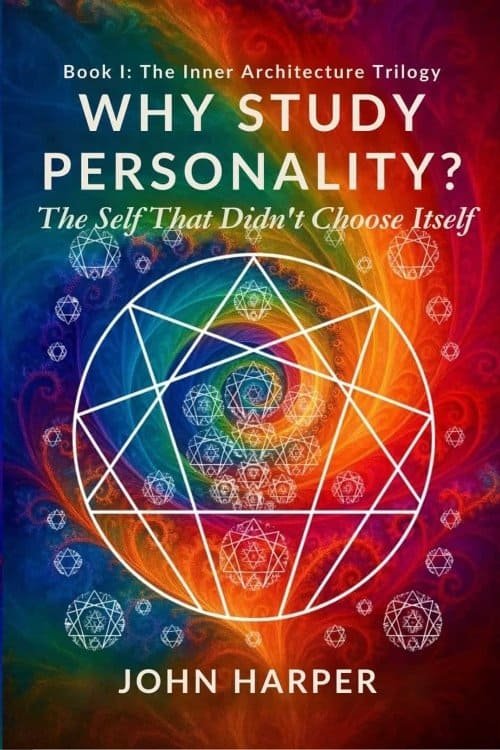
Why Study Personality? treats personality as an adaptive organization of perception, thought, emotion, and behavior that gradually comes to feel like “me.” The nine Enneagram patterns are not presented as definitions of identity, but as recurring ways consciousness organizes itself in response to life, then repeats those strategies until what was once adaptive becomes habitual and self-reinforcing.
The book uses the Enneagram as a mirror for seeing how awareness becomes identified with form. It explores the three centers, the architecture of perception, the human mechanism, resistance, and the nine types as different distortions of reality rather than fixed descriptions of who we are.
The practical aim is not to perfect personality, but to see it clearly enough that it becomes more transparent. The book moves from understanding the pattern toward recognizing the awareness that precedes it, using mental models, inquiry, and direct observation to interrupt habitual cognition and reopen perception.
At its deepest level, the book reframes the study of type as a path of remembering: not “Who is my type?” but What is this pattern organizing, what is it protecting, and what becomes visible when I no longer mistake it for the whole of who I am?
Frequently Asked Questions
Why Study Personality? begins where most Enneagram students begin, with personality type, yet it asks a different question about why we study personality in the first place. Rather than using type primarily to define ourselves more accurately, the book explores personality as an adaptive organization of perception, thought, emotion, and behavior that gradually becomes experienced as “me.” The purpose of studying the pattern is to see it clearly enough that we are no longer confined by it.
What is the real purpose of knowing your Enneagram type?
The deeper purpose of knowing your Enneagram type is to recognize the pattern you have mistaken for yourself. Type can provide valuable insight into your motivations, defenses, habits, emotional reactions, and ways of relating, but self-description is only the beginning.
Why Study Personality? treats each type as a particular way consciousness has learned to organize experience. Once the pattern becomes visible, the question changes from “How can I become a better version of my type?” to “What happens when I see this pattern operating without automatically becoming it?” The Enneagram then becomes less a system of identification and more an instrument of self-observation, inquiry, and freedom.
Is the Enneagram more than a personality typing system?
Yes. In this book, personality typing is one application of the Enneagram, not its deepest purpose. The nine types are useful because they reveal recurring ways perception, cognition, emotion, and attention become organized, yet the book uses those patterns to investigate something deeper: how awareness becomes identified with a particular organization and experiences that organization as a self.
Seen this way, the Enneagram becomes a mirror of consciousness rather than simply a catalogue of personalities. Type tells us something important about the shape of our habitual experience, while the deeper inquiry asks what remains when that habitual organization is seen clearly enough to become transparent.
Am I my Enneagram type?
No. Your Enneagram type describes a recurring pattern of organization; it does not define what you fundamentally are. A type describes characteristic ways attention moves, perception filters experience, emotion organizes meaning, and behavior repeats familiar strategies.
Because these movements become deeply habitual, they eventually feel like identity: This is simply who I am. The book challenges that assumption. It presents personality as a prism through which awareness is refracted into recognizable patterns while pointing toward the “light” that exists prior to the pattern. The type is real as a pattern, but the pattern is not the whole of you.
Can you outgrow your Enneagram type?
You can outgrow identification with your Enneagram type without erasing the pattern itself. Why Study Personality? does not propose replacing one type with another or destroying personality. It describes a movement in which the pattern becomes increasingly visible as a pattern rather than remaining an unquestioned identity.
This is why the book speaks of a “path beyond type.” The movement is from compulsion toward consciousness, from automatically inhabiting the pattern toward seeing how it thinks, perceives, interprets, and reacts. Personality may continue to color experience, but awareness becomes more spacious than the habitual organization it once took for itself.
Does personality describe who I am, or how I learned to function?
Personality describes how you learned to organize experience and function within life more accurately than it describes who you fundamentally are. The book presents personality as a functional and adaptive structure shaped by temperament, environment, necessity, and repeated responses to experience.
What begins as adaptation gradually becomes habitual. Ways of perceiving, protecting, relating, anticipating, achieving, withdrawing, controlling, or maintaining connection repeat until they acquire the apparent solidity of identity. The crucial distinction is between having a pattern and being the pattern. Why Study Personality? is concerned with making that distinction experiential rather than merely intellectual.
How does personality become an identity?
Personality becomes identity through repetition, identification, and the gradual organization of experience around familiar patterns. A response that once served adaptation is repeated; repeated responses become habits, habits influence perception, and perception increasingly confirms the same conclusions about ourselves and the world.
Eventually the pattern becomes self-reinforcing. We do not merely think, feel, or respond in a particular way; we begin to experience that familiar organization as me. The book describes this as awareness becoming caught within its own constructions. Seeing the process in real time begins to loosen the apparent equivalence between the pattern occurring and the person being the pattern.
Why do personality patterns become so automatic?
Personality patterns become automatic because repetition turns adaptive responses into efficient, self-reinforcing ways of organizing experience. The mind continually interprets what happens through memory, expectation, established meanings, and familiar conclusions. Over time, these interpretations occur so quickly that we experience the resulting world as reality rather than as reality filtered through a patterned system.
This is why simply knowing your Enneagram type may have surprisingly little effect on the pattern itself. You may recognize what you are doing while you are doing it and still continue doing it. The deeper work is learning to observe how interpretation and reaction arise before automatically obeying them.
Does Enneagram type come from childhood, temperament, adaptation, or trauma?
In Why Study Personality?, type is understood as an adaptive organization shaped by temperament, environment, necessity, and early experience rather than being reduced to any single cause. The book does not treat personality simply as pathology or as evidence that something went wrong.
The developing person finds ways to secure love, belonging, safety, orientation, and continuity. These strategies are intelligent adaptations to the conditions encountered, and through repetition they become increasingly stable. Trauma may influence this development, but the model is broader than trauma: personality reflects the interaction between the organism and the world it had to learn to inhabit.
The book therefore approaches personality with curiosity rather than condemnation. What later constrains us may once have helped us adapt, belong, protect ourselves, or remain connected.
What does growth look like for each Enneagram type?
Growth means becoming increasingly able to see your type’s organizing strategy rather than automatically living from inside it. The book gives each Enneagram type different reflective lenses because the mechanism that needs to become visible differs from type to type.
For One, the movement is from compulsive correction toward precision without judgment; for Two, from automatic helping toward love that includes autonomy; for Three, from performance toward authenticity; for Four, from longing toward creative participation; for Five, from retreat into knowledge toward direct knowing and wonder; for Six, from vigilance toward trust and faith; for Seven, from escaping into possibility toward presence; for Eight, from defensive control toward embodied strength that can yield; and for Nine, from inertia and merging toward conscious participation. These are presented as experiments in awareness rather than new personality ideals to achieve.
If personality helped me survive and adapt, why would I want to move beyond it?
You move beyond identification with personality because an adaptation that was once useful can become unnecessarily limiting when it remains the automatic organizer of present experience. The problem is not that personality exists. The problem arises when yesterday’s adaptive solution continues determining today’s perception before reality has a chance to be encountered freshly.
The book therefore does not ask you to reject the personality. It invites you to appreciate its intelligence while becoming curious about its limits. What once functioned as shelter can eventually become confinement if the organism continues repeating it long after the original conditions have changed. Moving beyond type means gaining the freedom to respond to what is actually happening rather than continually recreating what has happened before.
What is the difference between understanding my type and becoming free of it?
Understanding your type gives you knowledge about the pattern; freedom begins when you can see the pattern occurring without automatically becoming identified with it. You can know your motivations, defenses, childhood history, strengths, weaknesses, wings, and habitual reactions in extraordinary detail while the underlying organization continues operating exactly as before.
Why Study Personality? therefore shifts attention from accumulating information to observing personality as a living phenomenon. Its exercises and mental models are designed to interrupt habitual cognition, expose predictable conclusions, and create enough space for awareness to recognize what the mind is doing while it is doing it. Knowledge becomes transformational only when knowing gives way to seeing.
This is the distinction between studying the map of a pattern and catching the pattern in immediate experience.
What lies beyond personality?
Beyond personality is the awareness of Being within which personality appears. The book uses terms such as presence, awareness, Essence, and Being to point toward what becomes recognizable when habitual identification loosens.
This does not require personality to disappear. Thoughts still arise, emotions still move, perception continues, and the person’s ordinary capacities remain available. What changes is the relationship to them. Personality becomes more transparent, less compulsory, and less convincing as an ultimate identity; what had seemed to be the center of experience becomes something occurring within a larger field of awareness.
The book ultimately returns to the question with which it began: Why study personality? Because by seeing clearly how the self is constructed and sustained, we may discover that what we have been studying so carefully was never the entirety of who we are. As the book puts it, the Enneagram can become a path from compulsion to consciousness, from separation to participation, and from identification toward presence.