
Why You Aren’t Nine Personalities, but One Living Process
If you spend enough time around the Enneagram, you will inevitably encounter the familiar, well-meaning assurance: “Remember, we are all nine types.”
It’s usually offered as an invitation to wholeness, an antidote to boxing ourselves into narrow categories. Yet if we pause to examine the assertion within the conventional Enneagram model, a fundamental incoherence appears. If a type is understood as a fixed personality structure, a persistent organization of defense, core fear, and behavioral pattern, what does it actually mean to say we contain all nine? Does the psyche house nine distinct personalities sharing the same interior space? Do we become a Five when we withdraw to read, a Four when a wave of melancholy surfaces, a Nine when we seek comfort, and an Eight when we assert our will?
To interpret the symbol this way reduces a profound ontological map to a collection of shifting moods. Worse, it obscures the real nature of how consciousness organizes itself into the experience of being a separate self.
The Autonomous Grammar of Perception
The confusion begins with a deeply ingrained assumption: the belief that a central “I” orchestrates our experience, chooses strategies, and deploys defenses.
Teachings of essential inquiry point to an entirely different reality: consciousness is an undivided, self-unfolding field. Perception does not require an executive manager. The movements mapped by the Enneagram are not personality costumes we put on; they are the lawful, objective grammar through which reality organizes itself into manifestation.
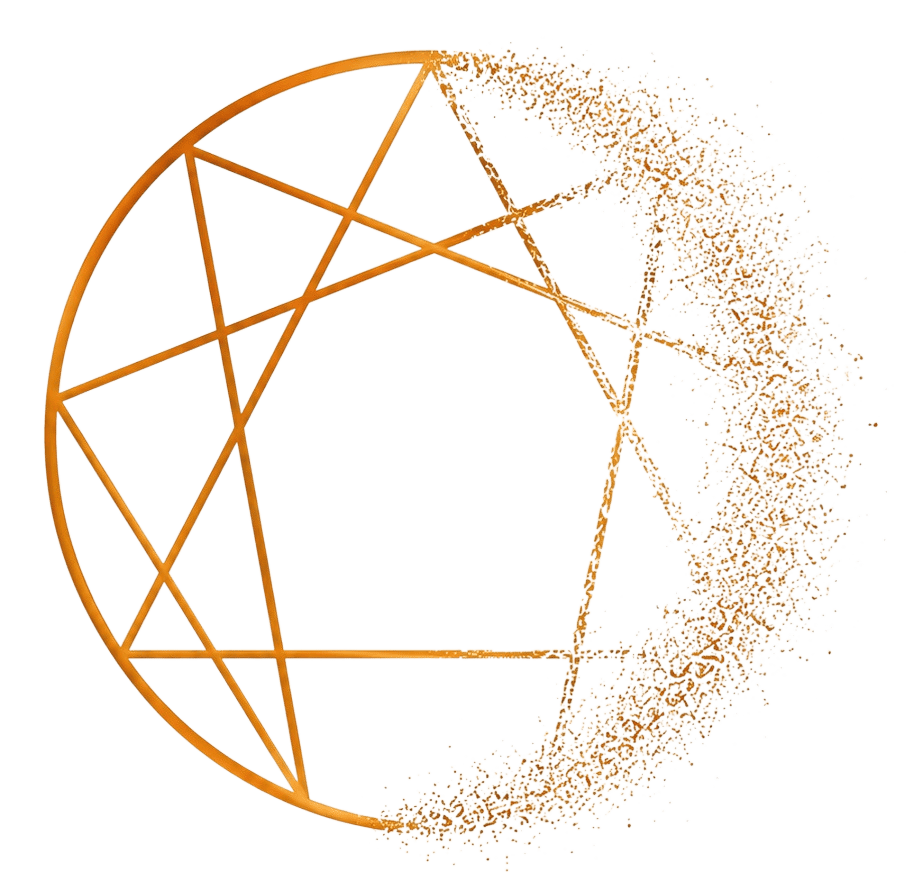
We are not all nine personality types. We participate in the universal processes from which the construct of personality emerges. Consider how the two primary geometries of the symbol function when freed from the static trait model:
- The Inner Triangle (3–6–9) and the Law of Three: The three fundamental forces—affirming, denying, and reconciling—continually meet raw reality, configuring perception into recognizable experience. This does not happen because you are doing it; the forces interact autonomously. Consciousness constructs your world long before any reflective “I” arrives to claim ownership of the result. Fixation occurs when consciousness establishes a habitual, repetitive pathway through these forces to maintain a familiar, predictable version of reality.
- The Hexad (1–4–2–8–5–7) and the Universal Tension Arcs: The hexad describes how consciousness modulates through manifestation, how it particularizes, turns inward, enters relationship, asserts autonomy, apprehends reality, and opens to possibility. When we examine the dynamic line between Point 2 (Connection) and Point 8 (Autonomy), we are not looking at two personality types swapping places. We are witnessing a universal human tension: How does the soul maintain relatedness without dissolving its particularity? Every human psyche lives within these universal energetic arcs.
The Developmental Sleight of Hand
If these processes are universal and continuously active in everyone, why do we experience ourselves as a single, fixed personality type? This points directly to the vulnerability of early human development. An infant cannot track the movement of universal forces. A young child cannot reflectively observe: “I see that consciousness is navigating the tension between autonomy and connection; I think I will simply rest as unconditioned Presence.”
The nascent psyche must stabilize. Long before self-reflective awareness is available, consciousness automatically takes up a position within these dynamic tension lines to preserve coherence and navigate its environment. It lands, and it builds a defensive scaffolding to hold itself together.
The great sleight of hand occurs as we mature: by the time the self-reflective mind develops enough to ask “Who am I?”, the automated stabilization that formed in childhood has already become the apparent subject doing the looking. Type is not an entity you possess. Type is what a fluid, universal process looks like when it freezes around the defense of a psychological identity.
Liberation, Not Collection
Seen from this perspective, inner work is not about acquiring the positive qualities of the other eight types, as though we were gathering missing pieces to complete an incomplete self. The other eight processes were never absent; they are functioning right now. The real movement is the loosening of fixation; it’s the gradual, compassionate seeing-through of the position consciousness took to protect itself.
When the defensive landing pad is recognized for what it is, an automated organization rather than our true nature, the necessity to hold the structure together begins to soften. Perception is no longer constrained to run through the same narrow channel of the triangle, and the energy of the hexad is freed to modulate naturally through its complete cycle: connection can become autonomy, autonomy can yield to apprehension, and possibility can give way to determination.
Inquiring Into the Living Process
Instead of asking which type you are inhabiting in a given moment, bring awareness to the immediate mechanics of your experience:
- Notice the arising of a defensive reaction—the urge to withdraw, control, appease, or judge. Can you see that this reaction is an autonomous movement of perception, rather than something “you” are deliberately choosing?
- What happens to the solid sense of your familiar personality when you simply allow the tension of the moment to exist, without defending the position you took long ago?
The work is not to become all nine types, but to let the fixed position dissolve back into the fluid, intelligent presence from which it arose.