A Call for Historical Rigor, Intellectual Honesty, and Verifiable Sources
The Enneagram does not need an invented ancient pedigree to be profound, useful, or worthy of serious study. Its value is not at issue here.
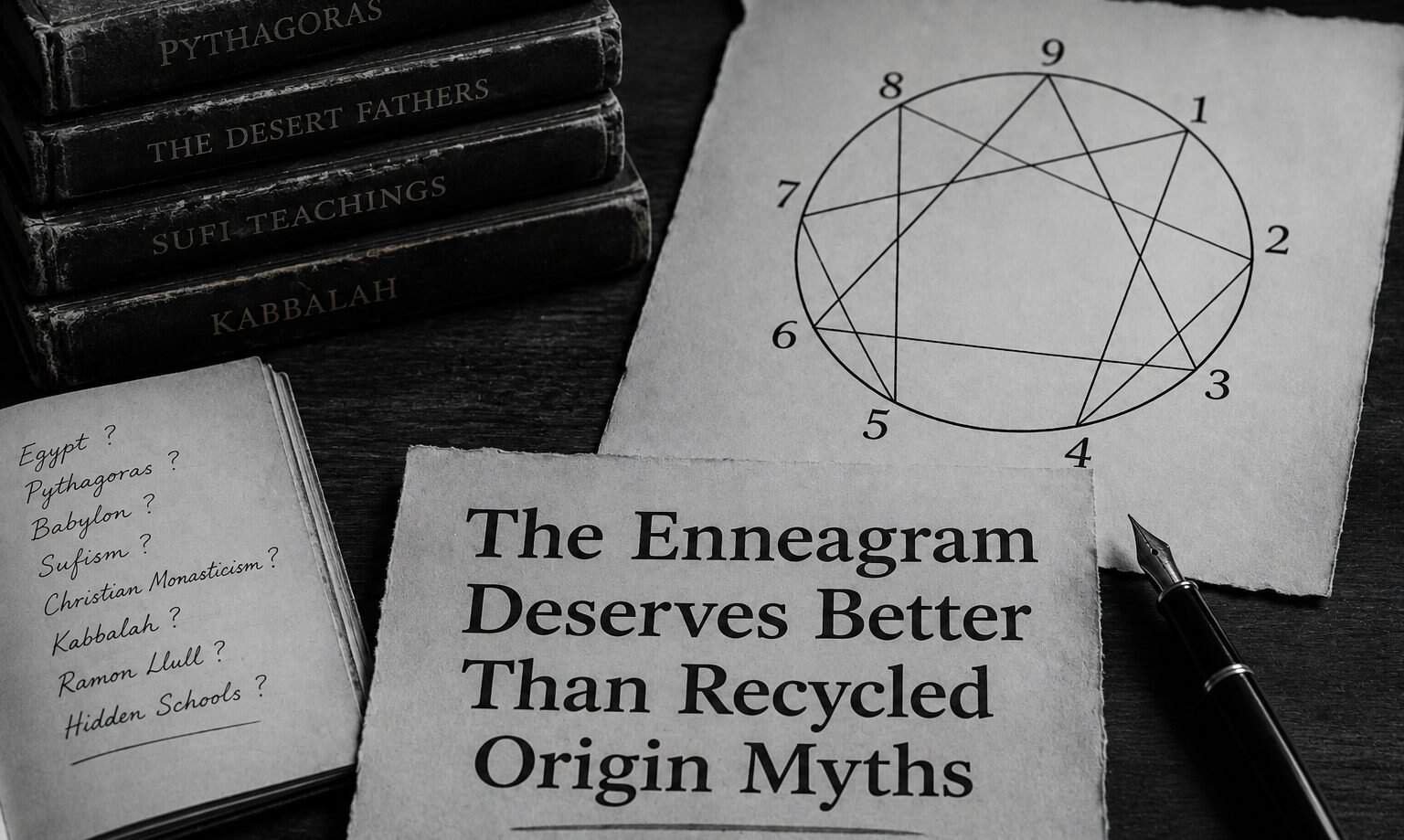
What is at issue is the modern habit of repeating claims about its origins—Egypt, Pythagoras, Babylon, Sufism, Christian monasticism, the Desert Fathers, Kabbalah, Ramon Llull, and various hidden schools—as though they were established historical fact, often without a primary source, a traceable citation, or evidence of serious research.
This is a challenge to authors, teachers, publishers, podcasters, and organizations: if you make a historical origin claim about the Enneagram, show the evidence because the Enneagram deserves to be treated as something more substantial than a social-media meme.
The Issue Is Not Meaning
People encounter the Enneagram as a practical map of personality, a language for self-observation, a framework for relationships, a spiritual discipline, a psychological model, or an invitation into transformation. None of that is diminished by historical honesty.
In fact, the opposite is true. When an author claims, “The Enneagram came from ancient Egypt,” “Pythagoras taught the Enneagram,” or “the Desert Fathers created the nine types,” without identifying a credible source, the claim makes the tradition less credible—not more; it substitutes atmosphere for scholarship.
Oscar Ichazo reported finding a medieval esoteric reference to a “Chaldean Seal” that he associated with the Enneagram. This is an autobiographical and interpretive claim, not currently a verified ancient Chaldean source for the particular symbol taught by Gurdjieff.
An ancient-sounding assertion may create mystique. It may sell books, or help a workshop introduction feel grand, but if it cannot be documented, it does not strengthen the Enneagram’s wisdom. It weakens the reader’s trust. A meaningful system should not need unsupported origin stories to command respect.
What Gurdjieff Actually Gives Us
G. I. Gurdjieff is the earliest securely documented modern teacher of the specific Enneagram symbol: the nine-pointed circle with the inner triangle connecting 3–6–9 and the internal figure joining 1–4–2–8–5–7. P. D. Ouspensky’s In Search of the Miraculous preserves the earliest substantial written account of its presentation in Gurdjieff’s teaching.
Gurdjieff made extraordinary statements about the symbol:
“All knowledge can be included in the enneagram and with the help of the enneagram it can be interpreted. And in this connection only what a man is able to put into the enneagram does he actually know, that is, understand.”
He also said:
“The knowledge of the enneagram has for a very long time been preserved in secret and if it now is, so to speak, made available to all, it is only in an incomplete and theoretical form of which nobody could make any practical use without instruction from a man who knows.”
These statements speak to the symbol’s scope, antiquity, and transmission; they are not historical citations.
Gurdjieff’s Answer About the Symbol’s Origin
When directly asked where the Enneagram symbol came from, Gurdjieff’s recorded reply was evasive and almost sarcastic: “Maybe I stole it.” He also called the Enneagram an “ancient science,” but did not name a specific Egyptian, Pythagorean, Sufi, Christian, or other historical tradition as its source. Nor did he provide a text, artifact, or chain of transmission that can be independently verified.
That is not a criticism of Gurdjieff; it’s simply an observation about the historical record. A teacher may preserve a meaningful body of knowledge without leaving scholars a documented account of every source from which it came. But later writers should not manufacture certainty where the primary record offers none.
Ouspensky’s comment is especially relevant:
“About where he had found the knowledge he undoubtedly possessed he spoke very little and always superficially.”
That statement should invite humility; it should not license certainty.
Do Not Confuse Teachings With Symbols
A recurring error in Enneagram writing is to identify parallels between older traditions and elements of Gurdjieff’s broader teaching, and then use those parallels as proof of the Enneagram symbol’s origin that does not follow.
J. G. Bennett observed that aspects of Gurdjieff’s overall teaching could be compared with Greek Orthodox, Muslim and Sufi, Buddhist, Platonic, Rosicrucian, Assyrian, Babylonian, and other traditions. But Bennett’s observation concerned the wide field of Gurdjieff’s teachings—not a documented provenance for the Enneagram diagram.
This distinction is essential.
- A culture’s reverence for nine does not establish the Enneagram.
- Pythagorean interest in number and harmony does not establish the Enneagram.
- An Egyptian Ennead of nine deities does not establish the Enneagram.
- A Christian catalog of passions does not establish the Enneagram.
- A Sufi cosmology or spiritual psychology does not establish the Enneagram.
- A medieval circular diagram with nine positions does not establish the Enneagram.
To establish the origin of the symbol, one needs evidence of the symbol, not merely thematic cousins. Specifically, a claim of direct ancestry must address the defining configuration: the circle, the nine positions, the 3–6–9 triangle, the 1–4–2–8–5–7 figure, and a comparable interpretation of the inner lines.
What a Serious Claim Requires
If an author says the Enneagram has a particular ancient origin, readers deserve to see what the claim rests on. At minimum, a serious historical claim should provide:
- The author, title, date, language, and edition or manuscript reference for the alleged source.
- A verifiable location: archive, library, museum, critical edition, or scholarly publication.
- The original diagram or passage—not merely a modern paraphrase.
- A reliable translation if the source is not in English.
- Evidence that the source predates Gurdjieff rather than being influenced by him.
- Evidence that the source depicts the relevant figure—not merely something involving nine.
- Evidence of transmission, or a clear acknowledgment that the comparison is only a parallel and not proof of ancestry.
This is not an impossibly high bar; it’s the ordinary bar for asserting history. If a claim cannot meet it, the responsible language is straightforward:
- “There is a possible parallel.”
- “Some later teachers have proposed a connection.”
- “This is an oral-tradition claim.”
- “The documentary evidence is incomplete.”
- “This is conjecture, not an established lineage.”
Those sentences do not weaken a book; they demonstrate intellectual integrity.
Familiar Claims Need Evidence
Consider several claims that appear frequently in Enneagram literature.
“The Enneagram Comes From Egypt”
Ancient Egypt had an Ennead: a ninefold grouping of deities, especially associated with Heliopolis. That is historically real. But a group of nine gods is not the Gurdjieffian Enneagram diagram. It does not establish the Laws of Three and Seven, the 3–6–9 triangle, the 1–4–2–8–5–7 process sequence, or a line of transmission to Gurdjieff.
Gurdjieff made evocative comments about an older or hidden Egypt. But an undisclosed ancient source cannot be used as evidence unless it can be identified and examined. The accurate statement is not, “The Enneagram comes from Egypt.” It is: “Some people have associated the Enneagram with Egyptian ninefold religious imagery; no direct Egyptian source for Gurdjieff’s symbol has been demonstrated.”
“The Enneagram Goes Back to Pythagoras”
Pythagoras and later Pythagoreans investigated number, proportion, musical harmony, and geometry. That makes a Pythagorean association rhetorically appealing. But where is the Pythagorean source that contains the Enneagram?
Which fragment, treatise, diagram, inscription, or artifact shows the defining configuration? Which text explains the relation of the 3–6–9 triangle to the 1–4–2–8–5–7 figure? Which source supplies a transmission line from a Pythagorean school to Gurdjieff?
A later teacher calling the symbol “Pythagorean” does not make it so. A modern author’s belief that it may have roots in Pythagorean thought does not turn a possibility into historical fact. The more honest formulation is: “Pythagorean thought offers possible conceptual parallels around number and harmony. A direct Pythagorean source for the Enneagram symbol has not been established.”
“The Enneagram Is Sufi”
This may be the most plausible of the commonly asserted lineages, given Gurdjieff’s cultural geography and broad allusions to Sufi schools, but plausibility is not proof. A Sufi origin would require a Sufi teacher, a text, a date, a manuscript or reliable edition, a diagram, an interpretation, and a credible line of transmission to Gurdjieff. Until that work is done, “Sufi origin” belongs in the category of informed possibility—not historical fact.
“The Personality Types Are Ancient”
The modern personality Enneagram is not simply Gurdjieff’s symbol rediscovered. The contemporary type system was shaped through later developments, especially the work of Oscar Ichazo and Claudio Naranjo.
Gurdjieff’s Enneagram functioned primarily as a cosmological and process symbol related to the Laws of Three and Seven. It was not presented as the contemporary system of nine personality types now widely taught in books, coaching, workplaces, churches, and popular culture. Older typologies, passion systems, virtue-and-vice lists, and spiritual psychologies may be worth comparing with the modern types, but comparison is not descent.
The Cost of Careless Claims
The problem is not merely academic. When writers repeat claims without investigating them, they create a citation echo chamber. One contemporary book references another. A website cites an unsourced lecture. A social-media post condenses the assertion into a sentence. Eventually the sentence returns to print as “common knowledge.”
Over time, conjecture hardens into folklore and folklore begins to masquerade as scholarship. This lowers the standard for everyone. Readers who discover that an origin story was unsupported may reasonably wonder what else has been passed along without scrutiny.
The Enneagram does not become more credible because it is said to be 2,000, 4,000, or 10,000 years old. It becomes more credible when practitioners distinguish carefully among documented evidence, oral-lineage testimony, interpretive comparison, informed hypothesis, and personal belief.
To author a book and make historical claims without undertaking, or transparently relying upon, deep, verifiable research reduces the wisdom and value of the Enneagram to the level of social-media meme culture: repeat what sounds compelling, add confidence, and let repetition impersonate proof. That is not scholarship nor stewardship, and it’s not worthy of a system people claim can illuminate the deepest patterns of human being.
A Call for Better Authorship
Authors have influence. A claim made in a book can be repeated for decades, detached from its original qualification, and accepted by thousands of readers who assume it was researched. That carries responsibility. Before putting an ancient-origin claim into print, an author should ask:
- Have I examined the primary source?
- Am I citing a scholarly edition, an archival object, or merely another modern author?
- Does the source actually depict the Enneagram symbol, or only something involving nine?
- Does it predate Gurdjieff?
- Is there evidence of transmission, or am I relying on resemblance?
- Have I told readers what is known, unknown, inferred, and believed?
If the answer is no, revise, qualify, or remove the claim. Writing as though conjecture were fact does not honor the Enneagram’s depth. It’s reducing a serious body of work to the logic of viral content: something sounds ancient, someone repeats it confidently, and eventually no one asks for proof.
The Enneagram deserves better than that.
The Invitation
This is not a challenge to the Enneagram’s value; it’s a challenge to our standards. If there is a verifiable pre-Gurdjieff source for the actual Enneagram symbol, publish it. Identify it. Date it. Translate it. Make the evidence available for examination.
If there is evidence connecting the symbol to Egypt, Pythagoras, Sufism, Christian monasticism, Babylon, or another tradition, bring it forward in a form that serious students can assess. And if the evidence is not available, let us have the courage to say so.
We can still value oral traditions. We can still explore archetypal and symbolic parallels. We can still hold personal beliefs about perennial wisdom and transmission. We can still investigate possible connections with seriousness and imagination, but we should not call a possibility a fact merely because it has been repeated often.
The Enneagram is too consequential, too subtle, and too useful to be propped up by recycled myths. Its wisdom is not made greater by unsupported claims of antiquity; it’s made greater by honesty, rigor, and a willingness to let the evidence, not the allure of an ancient story, set the terms of what we say.
A Different Possibility
Another possibility deserves serious consideration: Gurdjieff may have created the Enneagram symbol, or substantially composed its particular form and meaning, and then situated it within the language of ancient, secret knowledge. That possibility need not diminish the Enneagram. It may instead reveal something about the depth of Gurdjieff’s insight into how a symbol can work upon a mechanical consciousness.
Gurdjieff repeatedly taught that ordinary human beings live in a condition of sleep, identification, suggestibility, and automatic reaction. A symbol presented merely as an ingenious modern diagram might be approached intellectually, categorized quickly, and set aside. But a symbol presented as an ancient key preserved in secret, requiring direct instruction, and capable of containing all knowledge creates a different kind of encounter. It interrupts habitual certainty; it invites sustained attention, humility, and work.
Whether Gurdjieff inherited the Enneagram, adapted earlier materials, or created the distinctive form himself, its value does not rest on an ancient pedigree. Its value rests on whether it functions: whether it reveals lawful patterns in process, exposes mechanical habits, supports self-observation, and helps a person move toward greater consciousness.
In that sense, the question of historical origin and the question of practical or transformative value must be kept separate. A symbol does not become true because it is old, nor does it become false because it is modern.
If Gurdjieff created the Enneagram, that possibility would not make him a fraud or reduce the symbol to a gimmick. It could instead underscore his brilliance: he may have fashioned a compact, memorable, psychologically potent image capable of carrying the Laws of Three and Seven into the attention of people otherwise governed by mechanical thought.
The historical question still matters. Authors should not present conjecture as fact, and they should not invoke Egypt, Pythagoras, Sufism, or hidden schools as established sources without evidence. But the absence of a verified ancient lineage does not invalidate the Enneagram.
It simply asks us to value it for what it does, rather than for the prestige of what we imagine it must be.
If You Make the Claim, Can You Answer the Question?
Imagine you are giving a book talk, promoting your new book or an upcoming workshop, when someone in the audience raises a hand and asks: “In your book, you say the Enneagram can be traced to ancient Egypt, Pythagoras, the Sufis, the Desert Fathers—or wherever you have traced it. What is your evidence?”
What is your answer? Can you name the primary source? Can you show the diagram, text, artifact, or documented line of transmission? Or does your answer eventually lead back to another modern author who repeated the same claim?
If you are willing to put the history in the book, you should be prepared to answer the question in the room.